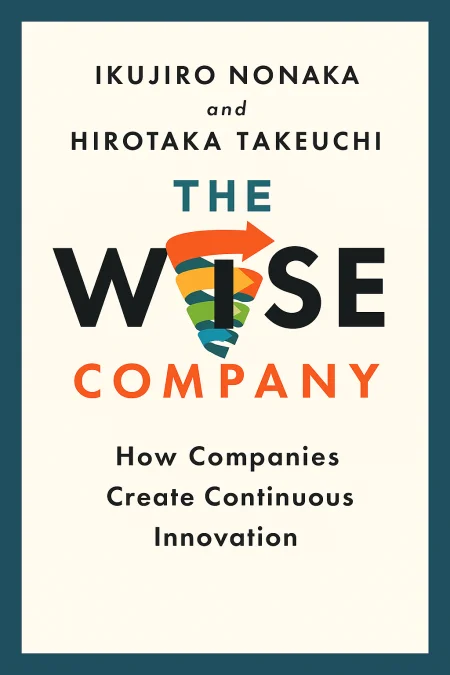
The Wise Company
How Companies Create Continuous Innovation
byIkujiro Nonaka, Hirotaka Takeuchi
Book Edition Details
Summary
In a world where change gallops ahead at breakneck speed, the secret to thriving lies not in mere adaptation but in mastering the art of perpetual innovation. "The Wise Company" by Ikujiro Nonaka and Hirotaka Takeuchi unravels this elusive formula, showcasing how visionary businesses transcend the chaos by weaving wisdom into the very fabric of their operations. This isn't just about staying afloat—it's about crafting a future on your own terms. Through real-world examples, Nonaka and Takeuchi illuminate how companies can align their goals with societal good, fostering an environment where knowledge is not only created but continuously reborn. At its heart, this book is a clarion call for leaders to embrace an intuitive understanding of human dynamics, ensuring that wisdom permeates through stories and shared experiences, driving sustainable success. For those seeking a roadmap to resilience in the twenty-first century, this book is an indispensable guide to forging a path of enlightened leadership and relentless reinvention.
Introduction
In an era where information flows at unprecedented speed and competitive advantages evaporate overnight, organizations face a profound challenge that transcends traditional management concerns. The question is no longer simply how to acquire knowledge, but how to transform that knowledge into wise action that creates sustainable value for all stakeholders. While countless companies have mastered the mechanics of data collection and analysis, few have developed the capacity to apply their insights with the kind of practical wisdom that enables long-term flourishing in complex, uncertain environments. The theoretical framework presented here introduces a revolutionary understanding of organizational learning that bridges the gap between knowledge creation and wise practice. At its foundation lies the concept of practical wisdom, or phronesis, which serves as the guiding force that transforms raw information into meaningful action. This approach addresses several fundamental questions that define organizational success in the modern era. How do companies evolve from mere information processors into entities capable of wise judgment and ethical action? What mechanisms enable the continuous spiral of learning that drives sustained innovation and adaptation? How can organizations develop distributed leadership capabilities that harness collective intelligence while maintaining moral grounding? These inquiries form the cornerstone of understanding how enterprises can transcend conventional boundaries to become truly wise organizations that serve both their own interests and the greater good of society.
The SECI Spiral: Dynamic Knowledge Creation Framework
The SECI Spiral represents a groundbreaking theoretical framework that reveals how organizations create and transform knowledge through four interconnected modes of conversion that work in continuous, dynamic interaction. This model fundamentally challenges linear approaches to knowledge management by demonstrating that organizational learning occurs through a spiraling process that moves between tacit and explicit forms of understanding, generating increasingly sophisticated capabilities with each iteration. The framework consists of four essential processes that form the backbone of organizational knowledge creation. Socialization enables the sharing of tacit knowledge through direct experience and interpersonal interaction, much like how master craftsmen transmit skills to apprentices through observation and practice rather than formal instruction. Externalization transforms this deeply personal, experiential knowledge into explicit concepts, frameworks, and documented practices that can be communicated and shared across organizational boundaries. Combination synthesizes different streams of explicit knowledge to create new theoretical frameworks and systematic understanding that transcends the sum of individual contributions. Internalization completes the cycle by converting explicit knowledge back into tacit know-how through practical application and embodied experience. The spiral nature of this process distinguishes it from static knowledge management approaches and explains how some organizations develop seemingly insurmountable competitive advantages. Consider how Toyota's renowned production system evolved through countless iterations of worker observations being externalized into improvement suggestions, combined with engineering principles to create new methodologies, and internalized through practice until they became second nature to employees. Each complete cycle of the SECI spiral elevates the organization to higher levels of capability, creating a self-reinforcing dynamic of continuous learning and improvement. The power of this framework lies in its recognition that knowledge creation is fundamentally a social phenomenon that transcends individual boundaries. As knowledge spirals upward from individual insights to team understanding, then to organizational capability, and finally to inter-organizational and societal impact, it creates expanding circles of value that benefit multiple stakeholders. This understanding transforms how we think about competitive advantage, revealing that sustainable success comes not from hoarding proprietary information but from developing superior capabilities for creating, sharing, and applying knowledge in ways that continuously generate new value and possibilities.
Phronesis and Six Practices of Wise Leadership
Phronesis, the ancient Greek concept of practical wisdom, emerges as the critical force that elevates knowledge creation beyond mere information processing to become a source of wise action that benefits both organizations and society. Unlike technical expertise or theoretical knowledge, phronesis represents the capacity to make sound judgments in specific, complex situations where rules and formulas prove insufficient, requiring leaders to integrate analytical thinking with moral reasoning and contextual sensitivity. This form of wisdom operates through three interconnected dimensions that distinguish wise leaders from merely competent managers. First, it demands deep contextual understanding that recognizes how cultural factors, historical circumstances, and situational nuances shape the appropriateness of different actions. Second, it requires moral reasoning that goes beyond compliance with rules to embrace ethical judgment about what constitutes right action in particular circumstances. Third, it involves the courage to act decisively despite uncertainty, drawing upon experience, values, and intuition to navigate uncharted territory with both confidence and humility. The cultivation of practical wisdom manifests through six interconnected practices that can be developed and institutionalized within organizations. Judging goodness involves the ability to evaluate options not merely on efficiency or profitability but on their contribution to human flourishing and long-term value creation. Grasping essence requires the skill to perceive underlying patterns and fundamental truths beneath surface complexity, enabling leaders to address root causes rather than symptoms. Creating shared contexts involves establishing environments where diverse perspectives can interact authentically to generate collective insights that transcend individual limitations. Communicating essence demands the ability to articulate complex insights in ways that inspire understanding and action across different audiences and organizational levels. Exercising political power encompasses the wise use of influence and authority to align diverse interests toward common purposes while respecting individual dignity and autonomy. Fostering practical wisdom in others represents the ultimate practice, developing organizational capabilities that distribute wise judgment throughout the enterprise rather than concentrating it in senior leadership positions. The integration of these practices creates organizational cultures that naturally generate continuous innovation while maintaining strong ethical foundations. Companies like Honda demonstrate this integration when their engineers develop breakthrough technologies not merely to gain competitive advantage but to address societal challenges like environmental protection, combining technical excellence with moral purpose in ways that create value for multiple stakeholders simultaneously.
Building Ba: Shared Contexts for Distributed Wisdom
The concept of Ba represents a revolutionary approach to organizational design that enables the emergence of distributed leadership and collective wisdom through the creation of dynamic, shared contexts for knowledge creation and practical application. Unlike traditional hierarchical structures that concentrate decision-making authority at the top, Ba creates spaces where leadership can emerge organically based on expertise, insight, and situational requirements, fostering environments where practical wisdom can develop and spread throughout the organization. Ba operates as both physical and virtual spaces characterized by high levels of trust, psychological safety, and shared purpose that enable participants to transcend their usual organizational boundaries and engage in authentic dialogue, collaborative problem-solving, and collective learning. These contexts are distinguished not by their formal structure but by their capacity to facilitate the spontaneous emergence of insights and solutions that no individual could generate alone, creating what might be called organizational phronesis where wise judgment becomes embedded in the culture rather than dependent on individual leaders. The practical manifestation of Ba can be observed in four distinct forms that support different aspects of the knowledge creation process. Originating Ba provides spaces for sharing experiences and mental models through face-to-face interaction, enabling individuals to absorb tacit knowledge and develop intuitive understanding through direct engagement with others. Dialoguing Ba offers forums for reflection and conversation where tacit insights begin to be articulated and shared, creating opportunities for collective sense-making and the emergence of new perspectives. Systemizing Ba creates environments where explicit knowledge can be combined, tested, and refined through systematic analysis and integration, functioning like laboratories where documented insights are validated and developed into comprehensive frameworks. Exercising Ba provides contexts where knowledge is applied and internalized through practice, enabling individuals to develop embodied understanding and practical capabilities that prepare them for future challenges and opportunities. The power of Ba lies in the dynamic flow between these different contexts, creating rich ecosystems where knowledge can emerge, evolve, and embed itself in organizational capabilities. Companies like 3M exemplify this approach through policies that encourage employees to pursue personal projects and cross-functional collaboration, creating multiple forms of Ba where innovation can flourish naturally rather than being confined to formal research and development departments. This comprehensive approach enables organizations to harness collective intelligence while maintaining the flexibility and adaptability necessary to thrive in complex, rapidly changing environments.
Summary
The essence of organizational wisdom lies in the recognition that sustainable competitive advantage emerges not from the accumulation of information but from the development of dynamic capabilities for creating, sharing, and applying knowledge in ways that serve both organizational success and societal flourishing. This framework reveals that truly wise companies transcend the traditional boundaries between profit and purpose, efficiency and ethics, individual achievement and collective good, demonstrating that these apparent tensions can be resolved through the application of practical wisdom that integrates moral judgment with effective action. The implications extend far beyond business strategy to encompass a new understanding of how human organizations can evolve to address the complex challenges of our interconnected world, offering hope that wisdom and prosperity can be mutually reinforcing forces in the creation of a more sustainable and equitable future for all stakeholders.
Related Books
Download PDF & EPUB
To save this Black List summary for later, download the free PDF and EPUB. You can print it out, or read offline at your convenience.
By Ikujiro Nonaka
