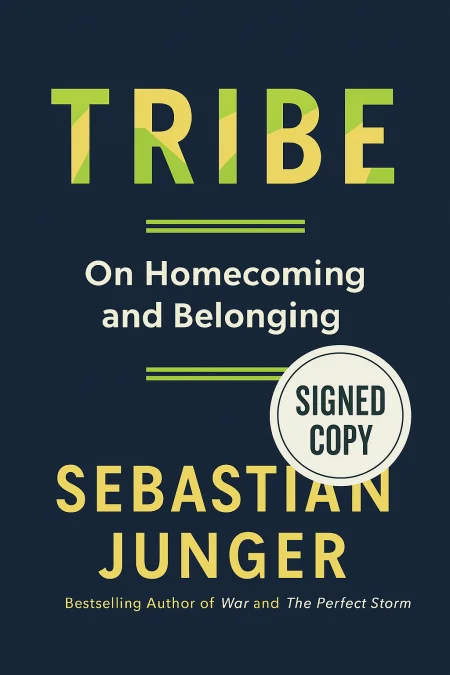
Tribe
On Homecoming and Belonging
Book Edition Details
Summary
In a world where chaos forges connection, Sebastian Junger's "Tribe" exposes the profound paradox of modern life. Through the eyes of veterans returning to a society that feels alien, Junger explores the timeless tribal instincts—loyalty, cooperation, and interdependence—that emerge in the heat of battle yet vanish in peacetime monotony. With insights drawn from history, psychology, and anthropology, this compelling narrative challenges us to reconsider the silent battles fought within civilian life. Why does the very society veterans defend seem so inhospitable upon their return? Junger's investigation reveals a troubling dissonance between our innate need for community and the isolating structures of contemporary existence. As veterans navigate the chasm between camaraderie and isolation, "Tribe" offers a poignant reflection on what truly binds us as humans.
Introduction
Modern society presents us with a fundamental paradox: despite unprecedented material prosperity and technological advancement, rates of depression, anxiety, and social isolation continue to climb. This contradiction reveals a profound disconnect between what human beings need to thrive and what contemporary civilization actually provides. Through careful examination of historical evidence, anthropological research, and psychological studies, a compelling case emerges that our evolutionary heritage as tribal creatures remains at odds with the individualistic structure of modern life. The analysis draws upon diverse sources ranging from colonial accounts of white captives who refused to leave Native American tribes, to psychological studies of combat veterans, to observations of community behavior during disasters. By exploring why humans consistently form tight-knit groups under adversity yet struggle with isolation during peacetime, we can better understand the costs of progress and identify pathways toward rebuilding essential social bonds. The investigation challenges us to reconsider whether our current definition of societal success truly serves human wellbeing.
The Tribal Society Paradox: Why Civilization's Enemies Attract
Throughout American history, a striking pattern emerged that confounded colonial authorities: white captives of Native American tribes consistently refused repatriation to "civilized" society. Benjamin Franklin observed that liberated captives would escape at the first opportunity to return to their adopted tribes, while Native Americans almost never chose to remain in white society. This phenomenon reveals fundamental truths about human social needs that transcend cultural boundaries. Tribal societies offered something modern civilization cannot: genuine equality, shared resources, meaningful work, and unbreakable social bonds forged through mutual dependence. The appeal lay not in material comfort, which colonial society clearly surpassed, but in social structure. Tribal communities eliminated the class distinctions, economic inequality, and social isolation that characterized European settlements. Personal property remained minimal, preventing the accumulation of wealth that creates hierarchies. Leadership was earned through demonstrated competence rather than inherited status, and decisions affecting the group required consensus rather than submission to distant authority. Most importantly, survival depended on every member's contribution, creating a society where no one was superfluous or forgotten. Modern research on hunter-gatherer societies confirms these historical observations. The !Kung people of the Kalahari Desert worked only twelve hours per week to meet their survival needs, spending far less time in labor-intensive activities than contemporary urban professionals. Their emphasis on resource sharing and collective decision-making created what anthropologists recognize as humanity's default social organization. The genetic adaptations that allowed humans to thrive in such communities developed over millions of years and remain largely unchanged, suggesting our psychological and social needs still align with tribal rather than modern living patterns. This historical evidence challenges the assumption that technological progress automatically improves human wellbeing. The consistent preference for tribal life among those who experienced both systems suggests that certain fundamental human needs may be better satisfied in simpler, more communal arrangements than in complex, individualistic societies.
War and Crisis as Community Catalysts: Unity Through Adversity
Catastrophic events consistently produce an unexpected psychological phenomenon: despite material hardship and physical danger, communities under stress often experience improved mental health and social cohesion. During the London Blitz, psychiatric hospital admissions declined, suicide rates dropped, and chronic conditions showed remarkable improvement. Citizens reported feeling more connected to their neighbors and more purposeful in their daily lives than during peacetime. This pattern repeats across cultures and throughout history, suggesting that human beings possess evolved responses that treat collective struggle as an opportunity for social bonding rather than individual trauma. The mechanism appears rooted in our evolutionary past, when survival depended on group cooperation during crises. External threats eliminate petty social divisions and redirect energy toward collective goals. Class distinctions become irrelevant when everyone faces the same danger, income disparities meaningless when survival depends on mutual aid rather than individual wealth. The resulting social unity provides what psychologist Charles Fritz termed a "community of sufferers" that offers profound psychological benefits to participants. Research from various disaster sites confirms this pattern. After earthquakes, floods, and other catastrophes, communities typically experience temporary but dramatic reductions in crime, mental illness, and social conflict. People spontaneously organize resource-sharing networks, check on isolated neighbors, and volunteer for dangerous rescue operations. These behaviors emerge without institutional direction and often persist long after immediate dangers pass. The social bonds formed during collective hardship frequently outlast the crisis itself. War represents an extreme version of this phenomenon, creating the most intense form of group cohesion humans can experience. Combat units develop loyalty bonds that veterans often describe as stronger than family relationships. The willingness to sacrifice personal safety for group survival becomes not just acceptable but honorable, providing individuals with a sense of moral purpose rarely available in civilian life. Understanding this process helps explain why many veterans struggle with the transition to peacetime society, having experienced a level of social meaning and connection that ordinary life cannot match.
Modern PTSD: A Problem of Reintegration, Not Combat Trauma
Current approaches to post-traumatic stress disorder fundamentally misunderstand the condition by focusing on battlefield exposure rather than social reintegration challenges. Comparative analysis reveals that PTSD rates vary dramatically between societies based not on combat intensity but on community structure and veteran reintegration practices. Israeli soldiers, fighting wars literally in their backyards with broad civilian support, develop PTSD at rates far below American troops despite comparable or greater combat exposure. The difference lies in social context rather than individual pathology. Traditional warrior societies possessed sophisticated mechanisms for managing the psychological transition between combat and civilian roles. The Iroquois maintained separate leadership structures for war and peace, allowing warriors to fulfill essential protective functions without imposing military hierarchy on daily community life. Ritual ceremonies provided structured opportunities for warriors to process their experiences with community support while reaffirming their value to society. Most importantly, tribal communities needed their warriors for hunting, defense, and other essential tasks, ensuring returned fighters remained vital community members. Modern American society offers veterans neither structured reintegration processes nor clear post-service roles. Instead of meaningful work that utilizes military skills and maintains social connections, many veterans receive disability payments that incentivize permanent patient status. The emphasis on individual therapy rather than community healing isolates struggling veterans from the group bonds that originally gave their service meaning. Well-intentioned support often reinforces feelings of brokenness rather than acknowledging the warrior's continued capacity for contribution. The most effective treatment approaches recognize PTSD as fundamentally a disorder of social reconnection rather than individual pathology. Veterans who maintain strong social ties and find purposeful civilian work recover more quickly and completely than those who become isolated or dependent on institutional support. Communities that actively integrate veteran skills and perspectives into civilian projects provide the social meaning that makes psychological healing possible. This understanding shifts focus from fixing broken individuals to rebuilding the community connections that support human resilience.
Rebuilding Tribal Bonds in Contemporary Society
The path toward healthier social organization requires recognizing that human beings evolved for small-group cooperation and remain psychologically adapted to tribal rather than mass society. This recognition does not demand abandoning technological progress but rather structuring modern institutions to better serve fundamental human social needs. Successful approaches emphasize local community building, shared sacrifice, and meaningful interdependence rather than individual achievement and material accumulation. Contemporary examples demonstrate the possibility of tribal-scale organization within modern contexts. Israeli kibbutzim, intentional communities, and certain military units create environments where individual welfare depends on group success and personal identity flows from community contribution. These structures reduce rates of depression, anxiety, and social isolation by providing the sense of belonging and purpose that humans require for psychological health. The key elements include shared resources, collective decision-making, and mutual dependence for essential needs. Economic inequality represents perhaps the greatest obstacle to community building in wealthy societies. When basic survival no longer requires cooperation, social bonds weaken and individuals pursue private rather than collective goods. However, communities that voluntarily embrace resource sharing and limit individual wealth accumulation consistently report higher levels of satisfaction and social cohesion. The challenge lies in creating systems that provide tribal benefits without sacrificing the material advantages of modern technology. The solution requires conscious effort to rebuild social structures that emphasize collective welfare over individual advancement. This might involve neighborhood resource sharing, community decision-making processes, local production networks, and regular opportunities for mutual aid. Such arrangements provide the psychological benefits of tribal membership while maintaining access to modern medicine, communication, and other technological advantages. The goal is not to recreate ancient societies but to structure contemporary life around the social relationships that support human flourishing.
Summary
The fundamental insight emerging from this analysis reveals that human psychological wellbeing depends more on social connection and community purpose than on material comfort or individual achievement. Modern society's emphasis on personal success and technological solutions systematically undermines the tribal bonds that sustained our species throughout evolutionary history. The resulting epidemic of depression, anxiety, and social isolation represents not individual failure but systemic misalignment between human nature and contemporary social organization. By understanding how traditional societies maintained community cohesion and recognizing the circumstances under which modern people spontaneously recreate tribal relationships, we can identify practical approaches to rebuilding the social connections that make life meaningful. This work offers valuable insights for readers seeking to understand the roots of contemporary social problems and explore evidence-based approaches to creating more fulfilling community relationships.
Related Books
Download PDF & EPUB
To save this Black List summary for later, download the free PDF and EPUB. You can print it out, or read offline at your convenience.

By Sebastian Junger
