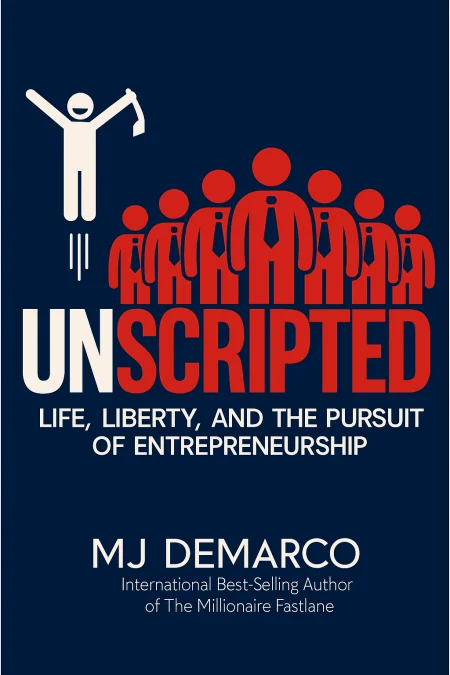
Unscripted
Life, Liberty, and the Pursuit of Entrepreneurship
Book Edition Details
Summary
Trapped in the relentless grind of a nine-to-five existence, have you ever questioned the script life handed you? MJ DeMarco's "Unscripted" takes a sledgehammer to the gilded cage of modern conformity, challenging the chains of debt and drudgery that masquerade as security. This is not a gentle nudge towards change; it's a full-throated call to arms for the dreamers, the rebels, and the visionaries. DeMarco dismantles the societal myths that keep you locked in mediocrity and unveils a daring alternative: the entrepreneurial path to true freedom. If you're ready to torch the rulebook and reclaim the life you've always imagined, "Unscripted" is your incendiary guide to breaking free from the mundane and forging a future of your own making.
Introduction
The alarm clock screams at 6:30 AM, and Maria feels that familiar knot in her stomach as she prepares for another day at the corporate office. Despite her MBA and fifteen years of climbing the ladder, she finds herself trapped in golden handcuffs—earning enough to maintain her lifestyle but never enough to truly break free. Her savings account grows slowly while her dreams fade faster, and she wonders if this cycle of trading time for money will ever end. The weekend offers only temporary relief before Monday's inevitable return, bringing with it the crushing weight of unfulfilled potential. This scene plays out in millions of lives across the world, where intelligent, capable people find themselves imprisoned by the very systems they were taught would set them free. The traditional path of education, employment, and retirement planning has become a sophisticated trap, designed to create compliant workers rather than empowered individuals. Yet beneath the surface of this scripted existence lies a different possibility—one where entrepreneurship becomes the key to unlocking not just financial freedom, but the freedom to design a life of meaning and purpose. The journey ahead reveals how to recognize the invisible chains that bind us to mediocrity, how to rewire the mental programming that limits our potential, and how to build businesses that serve others while setting ourselves free. This isn't about quick fixes or get-rich-quick schemes, but about fundamentally changing how we think about value creation, wealth building, and what it means to live an authentic life. The path requires courage, but the destination—true freedom—makes every challenge worthwhile.
Escaping the Matrix: Recognizing Society's Financial Programming
Sarah had always been the perfect student, following every rule society laid out for success. She graduated with honors, landed a prestigious corporate position, and diligently contributed to her retirement account each month. By thirty-five, she possessed everything the script promised would bring happiness: a steady salary, comprehensive benefits, and a retirement plan projecting comfort in her golden years. Yet as she sat in her corner office reviewing quarterly reports, a haunting question echoed in her mind: Is this really living, or just an elaborate form of surviving? The awakening came gradually, then suddenly. Sarah began noticing how her choices had been shaped by external expectations rather than internal desires. Her career path was chosen not for passion or natural talent, but for the illusion of security it provided. Her spending patterns were driven by social pressure and marketing messages rather than genuine needs. Even her financial planning was based on assumptions about what she should want rather than what would actually fulfill her. The most shocking realization was that the very system designed to protect her was actually limiting her potential. The corporate structure that promised advancement kept her skills narrow and her thinking confined within predetermined boundaries. The financial advice emphasizing safety over growth was ensuring she'd never accumulate enough wealth to be truly independent. The cultural messages about responsibility and stability were actually code words for conformity and mediocrity. She discovered that her beautiful downtown condo was really a prison, her car payments were chains, and her lifestyle had become a trap requiring her to remain employed regardless of how unfulfilled she felt. This recognition of the invisible matrix surrounding conventional life represents the first crucial step toward freedom. The scripts we've inherited—attend school, secure employment, save for retirement, repeat—aren't natural laws but constructed narratives serving others more than ourselves. Breaking free requires the courage to question everything we've been taught about success, security, and the supposed "right" way to live. Only when we clearly see the programming can we begin to rewrite our own code.
The Awakening Moment: When Comfort Becomes Prison
Marcus sat in his limousine on a snowy Chicago highway, stranded and alone after twelve grueling hours of chauffeuring wealthy executives. Despite holding two business degrees and years of grinding work, he faced a brutal truth: at twenty-six, he was nobody special. His expensive education had led to a dead-end job barely covering his bills, while his entrepreneurial dreams seemed as distant as the stars hidden behind storm clouds. In that moment of complete isolation, surrounded by the blizzard's fury, something fundamental shifted within him. The pain of his current reality finally exceeded his fear of change. This wasn't just another difficult day—it was his breaking point, the moment when continuing on his predetermined path became more terrifying than the uncertainty of forging a new one. He realized his life had been scripted by others' expectations, and if he wanted different results, he needed to write his own story. The comfortable misery of his routine job suddenly felt unbearable compared to the unknown possibilities of entrepreneurship. This pivotal moment—what we might call the "awakening event"—separates those who merely dream of change from those who actually create it. It's when familiar pain becomes intolerable, when the known suffering of staying the same finally outweighs the unknown challenges of transformation. Without this catalyst, most people remain trapped in cycles of complaint without commitment, interest without action, and dreams without the courage to pursue them. The awakening demands a fundamental shift from asking "How can I succeed within this system?" to "How can I create my own system?" The transformation isn't just about rejecting a bad job or difficult circumstances—it's about rejecting the entire framework that created those circumstances. It requires recognizing that the system isn't broken but working exactly as designed, just not for you. This awakening becomes the foundation for everything that follows, the moment when you stop trying to win a rigged game and start creating your own rules instead.
Building Value Systems: From Employee to Entrepreneur
David launched his first business with enthusiasm but made every classic mistake. He chased money instead of solving problems, focused on what he wanted to sell rather than what people wanted to buy, and spent more time perfecting his logo than understanding his customers. Failure after failure taught him a harsh but invaluable lesson: the marketplace doesn't care about your dreams, your financial needs, or your personal goals. It only cares about one thing—the value you provide to others. The breakthrough came when David stopped asking "How can I make money?" and started asking "How can I solve meaningful problems?" Instead of hunting for opportunities to extract wealth, he began seeking opportunities to create it. He shifted from being a consumer of other people's solutions to becoming a producer of solutions for others. This wasn't merely a business strategy—it represented a complete reorientation of his relationship with the world around him. The entrepreneurial framework operates on a simple but profound principle: massive value creation must precede massive wealth creation. While the scripted world teaches us to be consumers first—buying our way to happiness, status, and identity—the unscripted path demands we become producers first. This means creating products, services, or systems that genuinely improve other people's lives, making them easier, better, or more enjoyable. Success becomes a natural byproduct of service rather than the primary objective. This transformation extends far beyond starting a business; it fundamentally changes how you interact with the world. Instead of asking what you can get, you ask what you can give. Instead of focusing on your needs, you prioritize others' needs. Instead of trying to claim a bigger slice of the existing pie, you work to expand the entire pie for everyone. This shift from scarcity thinking to abundance thinking doesn't just change your bank account—it transforms your entire relationship with money, work, and life itself.
Freedom Disciplines: Protecting and Multiplying Wealth
Jennifer's awakening began when she realized her expensive downtown condo was actually a beautifully decorated prison. The mortgage payments demanded sixty-hour work weeks at a soul-draining job, the car payments required her to remain employed regardless of her misery, and credit card debt meant she couldn't afford to take risks or pursue opportunities. What she had mistaken for success was actually a sophisticated form of financial slavery—golden handcuffs that looked impressive but felt suffocating. Her path to freedom required completely redefining wealth itself. Instead of measuring success by what she owned, Jennifer began measuring it by what owned her. Instead of accumulating possessions, she focused on eliminating obligations. Instead of buying status symbols, she built systems generating passive income. The goal wasn't having more stuff—it was needing less stuff while maintaining the means to afford whatever truly mattered to her. True freedom manifests across five distinct dimensions: freedom from mandatory work, where labor becomes optional rather than obligatory; freedom from financial scarcity, where money becomes a tool rather than a master; freedom from social programming, where you become immune to cultural pressure and media manipulation; freedom from dependence on others, where your security comes from systems you control rather than systems controlling you; and freedom from routine obligations, where you design your days according to your values rather than others' schedules. These freedoms aren't achieved through extreme frugality or deprivation, but through intelligent design of your life and business systems. They require thinking differently about risk, security, and success. Most people seek security through dependence—relying on employers, stock markets, or government programs for their future. The entrepreneurial path creates security through independence—building systems and assets that function regardless of external circumstances. This isn't about becoming wealthy enough to buy anything you want; it's about becoming free enough to choose anything you want, including the wisdom to want less while having access to more.
Summary
The journey from scripted living to entrepreneurial liberation represents far more than changing careers or starting a business—it requires fundamentally rewiring how you think about life, work, and success. The stories throughout this exploration reveal a consistent pattern: those who break free from conventional paths don't succeed by following conventional wisdom, but by questioning it, challenging it, and ultimately replacing it with their own carefully designed systems. The most profound insight is that the script we've been following isn't neutral—it's deliberately designed to benefit everyone except us. The educational system prepares us to be compliant employees, the financial system keeps us dependent on institutions beyond our control, and the cultural narrative convinces us that freedom must be earned through decades of deferred dreams. Breaking free requires recognizing these systems for what they truly are and having the courage to consciously opt out. The path forward demands three fundamental shifts: from consumption to production, from dependence to independence, and from following others' scripts to writing your own authentic story. This isn't about rejecting all structure or becoming recklessly rebellious—it's about consciously choosing which games to play and which rules to follow. The unscripted life isn't easier than the scripted one, but it's infinitely more rewarding because it's authentically yours. The question isn't whether you can afford to take this path, but whether you can afford not to. Your future self is waiting for you to begin this transformation today.
Related Books
Download PDF & EPUB
To save this Black List summary for later, download the free PDF and EPUB. You can print it out, or read offline at your convenience.
By M.J. DeMarco
