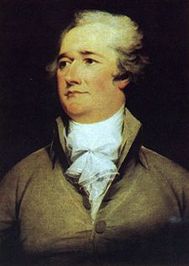
Alexander Hamilton
Born in the West Indies and rising to prominence in the nascent United States, Alexander Hamilton was a pivotal figure in the establishment of American government and economic systems. As the first Secretary of the Treasury from 1789 to 1795, Hamilton laid the groundwork for the nation’s financial infrastructure, founding the national bank and public credit system. His advocacy for a strong central government and the assumption of state debts reflected his belief in a robust federal structure. Hamilton's influence extended beyond economics; as a senior aide-de-camp to General George Washington during the Revolutionary War, he played a crucial role in the American victory at the siege of Yorktown. His life, however, was tragically cut short in a duel with Aaron Burr, a political rival. Hamilton’s literary legacy is most notably encapsulated in "The Federalist Papers," a collection of essays co-authored with James Madison and John Jay. These writings are considered a seminal work for Constitutional interpretation, offering profound insights into the principles and intentions behind the United States Constitution. The essays were instrumental in garnering support for the ratification of the Constitution, making Hamilton a central figure in shaping American political philosophy. Though his personal life was marred by scandal, including an affair with Maria Reynolds, Hamilton's contributions to political thought and economic policy have endured. Known for his eloquent prose and incisive arguments, Hamilton's writing style was characterized by its clarity and persuasive power. He was a visionary whose contributions to the American political landscape were foundational, influencing the development of the Federalist Party and shaping the nation's financial policies. Even after his death, Hamilton's economic strategies were revived by successors, acknowledging his foresight in matters of infrastructure and national defense. His legacy as a Founding Father and a vital architect of American governance continues to resonate in contemporary political discourse.


by Paul J. Zak
by Rory Vaden
by Robert C. Solomon, Fernando Flores
by Brett Gardner
by Dennis S. Reina
by Julian Baggini
by Larry Downes, Omar Abbosh, Paul Nunes
by Jacqueline Woodson
by Kevin Oakes
by Lindsey Pollak, Kimberly B. Cummings, Kimberly Brown
