
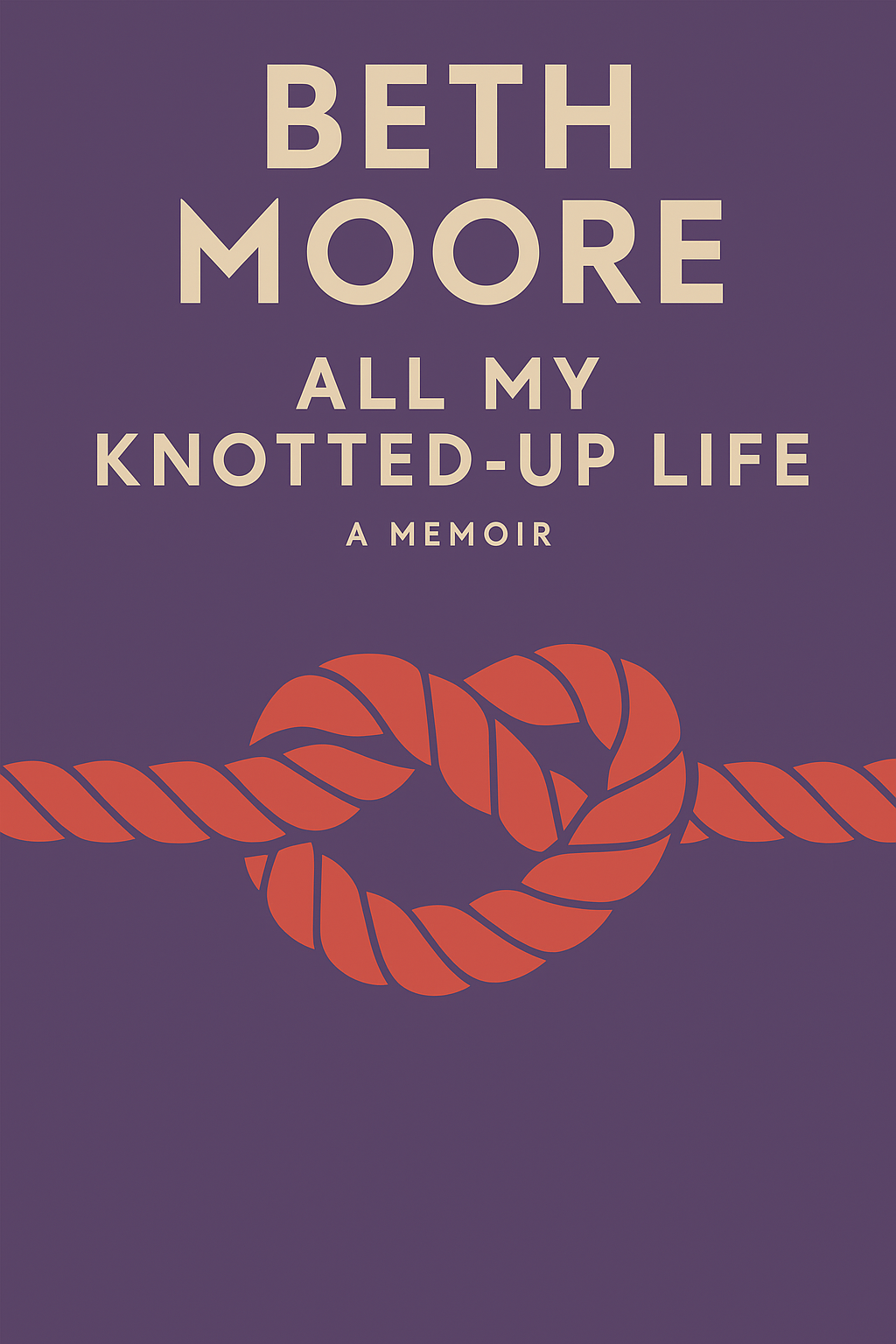
All My Knotted-Up Life
A Memoir
Book Edition Details
Summary
Beth Moore's "All My Knotted-Up Life" unravels the intricate tapestry of her journey with an intimacy and humor that's both disarming and inspiring. Stepping beyond the spotlight of her renowned ministry, Moore offers a candid reflection on the personal trials and triumphs that have shaped her indomitable spirit. With a voice that echoes vulnerability and strength, she shares the poignant tales of heartache and redemption, painting a vivid portrait of resilience against the backdrop of her spiritual odyssey. From the nuances of her Arkansas upbringing to the pivotal moments of faith that defined her path, Moore’s memoir is a testament to the unwavering grace that carried her through life's tangled paths. A compelling narrative for anyone eager to witness the profound depth beneath a familiar name, it reminds us that everyone’s story, when truly heard, leaves us awe-inspired and deeply moved.
Introduction
In the humid backwoods of Arkansas, where sweet gum trees drop their prickly balls and red clay stains everything it touches, a little girl with tangled blonde hair began a journey that would touch millions of hearts. Born into a world where silence was golden and secrets were currency, she learned early that life could be both beautiful and brutal, sometimes within the same hour. Her story unfolds against the backdrop of a changing America, where traditional Southern Baptist churches held sway over small-town life, and where women's voices in ministry were more whispered than proclaimed. Through decades of personal struggle, professional triumph, and spiritual wrestling, she would discover that the very knots that seemed to bind her life together were actually the threads God used to weave something extraordinary. From her readers, we learn of transformation through Scripture study, the courage required to speak truth in religious circles, and the profound discovery that our most painful experiences often become our greatest tools for healing others. Her journey reveals how authentic faith isn't about perfection, but about the willingness to remain vulnerable before God and others, even when the cost seems unbearable.
Roots and Wounds: Growing Up Green in Arkansas
The Green family lived their lives in Technicolor drama, where every emotion ran deep and every conflict echoed through their small Arkansas home like thunder through the hills. In Arkadelphia, a college town nestled at the feet of the Ouachita Mountains, the family of eight squeezed into whatever space they could afford, moving from the hill country to town as circumstances demanded. The matriarch, Aletha, chain-smoked her way through days that often felt too heavy to bear, while Albert, the stern patriarch and Army veteran, carried secrets that would cast long shadows over his children's lives. Their world was one of Southern Baptist tradition, where church attendance wasn't optional and proper behavior was paramount, yet beneath the veneer of respectability, darkness crept through the cracks. Young Beth absorbed the contradictions of her upbringing like a sponge soaking up muddy water. She learned to navigate between the safety of Sunday school classrooms, where Bible stories painted clear pictures of right and wrong, and the confusing reality of home, where those same moral lines seemed to blur and shift. Her grandmother Nanny, with her colorful vocabulary and no-nonsense approach to life, provided both comfort and complexity, offering unconditional love wrapped in the prejudices of her generation. The Royal Theater, where her father worked as manager, became a sanctuary of sorts, a place where stories unfolded predictably on silver screens, unlike the unpredictable narrative of her own life. The foundation of trauma laid in these early years would prove both devastating and, eventually, redemptive. What began as wounds that seemed too deep to heal would later become the very experiences that qualified her to minister to others carrying similar pain. The Arkansas hills that witnessed her childhood struggles would remain forever etched in her memory, not just as places of hurt, but as the fertile ground where her understanding of grace and forgiveness would eventually take root. Even in the darkest moments, when innocence was stolen and trust was shattered, the seeds of her future calling were being planted in soil that had been broken open by suffering.
Breaking Free: Marriage, Ministry, and Mental Health Battles
The young woman who walked down the aisle to marry Keith Moore carried invisible baggage that would take decades to unpack. Their union began as a collision between two broken people who mistook intensity for compatibility, each bringing their own catalog of wounds into a relationship that would require nothing short of miraculous grace to survive. Keith, haunted by childhood trauma from a house fire that claimed his brother's life, struggled with demons that would later be diagnosed as severe PTSD and bipolar disorder. Their early years of marriage unfolded like a complicated dance between love and survival, as they learned to navigate the treacherous waters of mental illness without a compass. Ministry emerged not from a place of strength, but from the desperate recognition that God must be bigger than their problems or they were lost. Her calling to vocational Christian service came during a summer camp experience that left her certain of divine purpose, even when she couldn't articulate what that purpose might look like. The path forward required threading the needle between her genuine gifts for teaching and the restrictive expectations placed on women in Southern Baptist circles. She learned to walk carefully, always ensuring she remained "under authority" and never posed a threat to the male leadership that dominated her religious world. The perfect storm of her thirties brought everything to a breaking point, when suppressed memories and unhealed trauma collided with the pressures of growing ministry responsibilities. For months, she lived in a twilight world where past and present blurred together, threatening not only her sanity but everything she held dear. The darkness that engulfed her during this period was so complete that she wondered if God had abandoned her entirely, yet it was precisely in this valley of shadows that the most profound healing began to take place. The woman who emerged from this crucible was fundamentally different, not because she was fixed, but because she was finally free. Keith's own battles with mental illness would ebb and flow throughout their marriage, creating seasons when she felt like she was living with a stranger in their own home. The man she loved would sometimes disappear behind a wall of depression so thick that no amount of love seemed able to penetrate it. Yet these struggles, rather than destroying their relationship, would ultimately become the forge in which their commitment was refined and strengthened, teaching them both that true love isn't just a feeling but a choice made daily, especially when feelings fail.
Arena Days: Success, Scrutiny, and Standing for Truth
The transition from small church classes to massive arena events felt like being catapulted from a community theater to Broadway without rehearsal time. When Living Proof Live began filling basketball arenas across the country, attracting tens of thousands of women hungry for deeper biblical teaching, the girl who once cowered from attention found herself thrust into a spotlight that would never dim. These gatherings became sacred spaces where women from all denominational backgrounds united around their shared desire to know Jesus more intimately through Scripture study. The energy was electric, the testimonies life-changing, and the presence of God so tangible that even skeptics found themselves moved to tears. Success, however, came with a price tag that included constant scrutiny from religious leaders who questioned a woman's right to teach with such authority and influence. She learned to navigate the treacherous waters of denominational politics, always careful to acknowledge male authority and downplay her own role, even as her ministry grew beyond anything anyone had anticipated. The irony wasn't lost on her that she could fill arenas with women eager to learn from her teaching, yet still found herself apologizing for taking up space in the religious landscape. The weight of visibility became almost unbearable as critics dissected her every word, looking for theological errors or signs of feminist rebellion. She developed an acute awareness of how different standards applied to men and women in ministry, watching male colleagues receive praise for the same boldness that earned her rebuke. The constant need to prove her orthodoxy while maintaining her authenticity created an exhausting internal tension that threatened to crush the very joy that had initially drawn her to ministry. When the 2016 election cycle forced her to choose between political loyalty and moral conviction, she made the decision to speak truthfully about sexual abuse, regardless of the consequences. The backlash was swift and merciless, with former supporters burning her books and flooding her ministry with angry calls demanding her silence. Yet in losing the approval she had spent decades carefully cultivating, she discovered something far more valuable: the freedom that comes from speaking truth without regard for human opinion. The girl who had once been silenced by trauma found her voice, and nothing would ever silence her again.
Finding Home: Love, Loss, and the Via Media
The final chapters of her story unfolded against a backdrop of profound loss and unexpected discovery, as the denominational family that had shaped her entire identity began to feel like a house that no longer fit. The Southern Baptist Convention that had nurtured her calling became the same organization that questioned her orthodoxy when she dared to speak against racism and abuse cover-ups. The pain of this rejection was perhaps the deepest wound of all, cutting to the very core of who she understood herself to be. Keith's miraculous return from years of mental absence coincided with her ecclesiastical exile, as if God orchestrated their healing to happen simultaneously. The husband who had been lost to her for so long came back just as she needed him most, providing strength and perspective as she navigated the most difficult transition of her life. Together, they discovered that love isn't just about enduring the storms but learning to dance in the rain, finding joy even in the midst of uncertainty and change. The death of her father brought complicated grief, as she wrestled with forgiving a man whose full story she would never know. Standing beside his hospital bed, holding the hand of someone who had caused her immeasurable pain, she chose grace over bitterness, releasing both him and herself from the prison of unresolved anger. The funeral, complete with military honors, became an unexpected celebration of the complexity that defines every human life, reminding her that people are rarely entirely good or entirely bad. Their accidental discovery of an Anglican church provided the surprising answer to their search for spiritual home. In liturgy and sacrament, they found ancient paths that led to the same Jesus they had always loved, but approached through traditions that emphasized mystery over certainty and inclusion over exclusion. The chapel Keith built for their retirement, unknowingly modeled after his grandparents' country church, became a symbol of how God weaves together the threads of our lives in ways we cannot see until the tapestry is complete. In this sacred space surrounded by trees, they found not just physical shelter but the spiritual home they had been seeking all along.
Summary
The tangled knots of a life lived honestly before God reveal themselves, in the end, to be the very ties that bind us securely to grace, to love, and to hope that transcends human understanding. Her journey from wounded child to wounded healer demonstrates that our deepest scars often become our greatest qualifications for ministry, not because pain makes us wise, but because it makes us humble enough to receive and extend mercy. For those wrestling with their own knotted-up lives, her story offers the radical possibility that God specializes in using broken things to accomplish beautiful purposes, and that the very experiences we wish we could erase might be the ones he uses to write love letters to a hurting world. The path from bondage to freedom rarely runs straight, and authentic faith is less about having all the answers than about maintaining the courage to keep asking questions, even when the questions lead us into unfamiliar territory. Her legacy lies not in the arenas she filled or the books she wrote, but in the countless women who discovered through her vulnerability that they too could bring their whole selves, including their broken parts, into the presence of a God who specializes in redemption.
Related Books
Download PDF & EPUB
To save this Black List summary for later, download the free PDF and EPUB. You can print it out, or read offline at your convenience.
By Beth Moore
