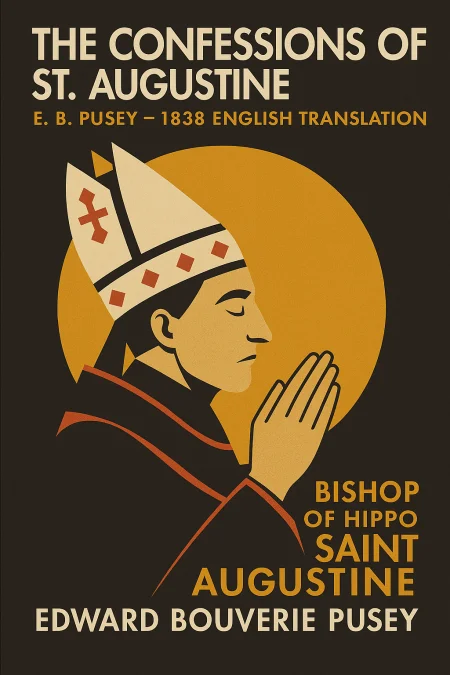
The Confessions of St. Augustine
E. B. Pusey 1838 English Translation
byBishop of Hippo Saint Augustine, Edward Bouverie Pusey
Book Edition Details
Summary
In the labyrinth of human consciousness, Saint Augustine stands at a crossroads, battling the shadows of doubt and desire. "Confessions" is not just a recounting of conversion; it's an intimate dance with introspection and a fervent quest for truth. Augustine's narrative unfurls with raw honesty as he navigates the tumultuous seas of sin, redemption, and divine love. Each page resonates with the echoes of his inner turmoil, revealing a heart laid bare in pursuit of grace. This timeless work captures the transformative power of faith, offering a profound glimpse into the mind of one of history's most pivotal spiritual thinkers.
Introduction
In the dying light of the Roman Empire, as barbarian tribes pressed against the frontiers and ancient certainties crumbled, one man embarked on perhaps history's most profound spiritual odyssey. Augustine of Hippo, born in North Africa in 354 AD, would become not merely a bishop or theologian, but the architect of Christian thought for the next millennium. His journey from a pleasure-seeking young rhetorician to Christianity's most influential thinker after Saint Paul reads like an epic of the human soul itself. Augustine lived through an age of transformation, when the old pagan world was giving way to a new Christian order. Yet his struggles were timeless: the battle between desire and duty, the search for meaning in a chaotic world, the longing for truth amid competing philosophies. His story reveals how one man's relentless self-examination and spiritual hunger led him to revolutionary insights about memory, time, and the nature of God. Through Augustine's eyes, we witness the birth pangs of medieval Christianity and discover enduring wisdom about the human condition. His journey offers us a mirror for our own spiritual searching and a testament to the transformative power of grace.
From Worldly Ambition to Spiritual Awakening
Augustine's early years were marked by an insatiable hunger for worldly success and sensual pleasure. Born to a pagan father and Christian mother in the provincial town of Thagaste, he possessed a brilliant mind that quickly mastered rhetoric and philosophy. His ambitions carried him from North Africa to Rome and finally to Milan, where he served as imperial orator, the pinnacle of academic achievement in the late Roman world. Yet beneath this glittering exterior, Augustine wrestled with profound spiritual restlessness. His intellectual journey led him through various philosophical schools, each promising truth but ultimately leaving him unsatisfied. The Manicheans, with their dualistic explanation of good and evil, initially captivated him with their claim to rational religion. For nine years, Augustine embraced their teachings, finding in them an apparent solution to the problem of evil that had tormented him since youth. However, as his philosophical sophistication grew, the contradictions and limitations of Manichaean doctrine became increasingly apparent. The turning point came through his encounter with Platonic philosophy and the preaching of Bishop Ambrose in Milan. The Platonists showed him that reality could be spiritual rather than material, while Ambrose demonstrated that Christian scripture could be interpreted allegorically rather than literally. These discoveries shattered Augustine's intellectual objections to Christianity, yet he remained bound by chains of habit and sensual desire. Augustine's internal struggle intensified as he recognized the truth of Christianity intellectually but found himself unable to embrace it fully. His famous prayer, "Give me chastity and continence, but not yet," perfectly captured his divided will. He wanted to want God, but his immediate desires pulled him in the opposite direction, creating a psychological torment that would profoundly influence his later theological insights about human nature and divine grace.
The Garden Conversion and Baptismal Rebirth
The climax of Augustine's spiritual journey occurred in a garden in Milan during the summer of 386 AD. Overwhelmed by stories of others who had abandoned worldly success for Christian service, Augustine found himself in the grip of an emotional and spiritual crisis that would change not only his life but the course of Christian history. His friend Alypius watched in bewilderment as Augustine threw himself beneath a fig tree, weeping and crying out to God about his inability to break free from his old life. In this moment of supreme anguish, Augustine heard a child's voice chanting "Take up and read, take up and read." Interpreting this as a divine command, he opened Paul's letter to the Romans and read: "Not in reveling and drunkenness, not in lust and wantonness, not in quarrels and jealousy. Rather, arm yourselves with the Lord Jesus Christ; spend no more thought on nature and nature's appetites." The words struck him like lightning, instantly dissolving years of internal conflict and filling him with supernatural peace. This garden experience marked Augustine's definitive conversion, but it was followed by a period of careful preparation for baptism. He resigned his teaching position and retreated with friends and family to a villa at Cassiciacum, where he spent months in philosophical dialogue and spiritual reflection. These conversations, later recorded in his early works, show Augustine working through the intellectual implications of his newfound faith while experiencing the joy of liberation from his former struggles. Augustine's baptism by Bishop Ambrose at Easter 387 AD represented not merely a religious ritual but a complete transformation of identity. The brilliant rhetorician who had sought fame and pleasure now dedicated his life entirely to understanding and serving God. This rebirth would soon lead him back to North Africa, where he would reluctantly accept ordination as a priest and later as bishop of Hippo, positions that would provide the platform for his monumental contributions to Christian thought and practice.
Wrestling with Memory, Time, and Scripture
As Augustine matured in his Christian faith, he turned his formidable intellect toward understanding the deepest mysteries of human existence and divine revelation. His exploration of memory in his spiritual autobiography reveals a mind grappling with the very foundations of consciousness and identity. Augustine recognized memory as the vast palace of the mind, containing not only past experiences but also mathematical truths, emotional states, and even the memory of forgetting itself. This investigation led him to profound insights about the continuity of personal identity and the mysterious ways in which the human soul participates in eternal truth. Augustine's meditation on the nature of time produced some of the most penetrating philosophical analysis in Western thought. Confronting the question of what God was doing before creation, Augustine realized that time itself is a created reality, existing only within the physical universe. His famous observation that the present has no duration, being merely the knife-edge between past and future, led him to understand time as a "distension of the soul" - a mental phenomenon by which consciousness holds together memory of the past and anticipation of the future in the eternal now of awareness. These philosophical investigations were never merely academic exercises for Augustine but were intimately connected to his spiritual journey and pastoral responsibilities. As bishop of Hippo, he found himself constantly called upon to interpret Scripture and defend Christian doctrine against various heresies. His approach to biblical interpretation, developed through years of struggle with difficult passages, emphasized both the literal and spiritual senses of the text while insisting on the fundamental principle that Scripture interprets Scripture. Augustine's wrestling with divine revelation culminated in his recognition that human reason, though valuable, must ultimately submit to faith. This was not anti-intellectualism but rather the mature insight of a brilliant mind that had discovered the limits of purely rational inquiry. His famous formulation "faith seeking understanding" would become the foundation for medieval scholasticism and remains influential in theological circles today.
Trinity, Creation, and the Path to Eternal Rest
Augustine's theological masterpiece on the Trinity represents the culmination of decades of reflection on the deepest mysteries of Christian faith. Faced with the challenge of explaining how God could be simultaneously one and three, Augustine developed analogies from human psychology that would influence Christian thought for centuries. His exploration of the mind's threefold activity of memory, understanding, and will provided a framework for comprehending divine unity in diversity, though he always insisted that such analogies were merely shadows of an ultimately incomprehensible mystery. His interpretation of the Genesis creation account revealed Augustine's mature synthesis of Christian faith and philosophical insight. Rather than seeing the six days of creation as literal time periods, Augustine understood them as logical rather than temporal distinctions in God's eternal creative act. This interpretation allowed him to maintain both the biblical account and the philosophical principle that God acts outside of time. His concept of creation ex nihilo - from nothing - became standard Christian doctrine and provided a foundation for later scientific and philosophical developments. Augustine's vision of human destiny centered on the concept of eternal rest in God. Drawing from his own experience of restless seeking and ultimate satisfaction in divine love, he articulated a theology of human longing that resonated across cultures and centuries. His famous opening words, "You have made us for yourself, O Lord, and our hearts are restless until they rest in you," captured both the universal human experience of dissatisfaction with finite goods and the Christian promise of ultimate fulfillment in divine communion. The bishop of Hippo's final years were marked by barbarian invasions and the apparent collapse of Roman civilization, yet Augustine maintained his focus on eternal rather than temporal concerns. His monumental work distinguishing between earthly and heavenly citizenship provided a framework for understanding history as the unfolding of God's providential plan. This work would profoundly influence medieval political theory and continues to offer insights into the relationship between faith and public life.
Summary
Augustine's life demonstrates that the deepest intellectual and spiritual satisfaction comes not from avoiding difficult questions but from wrestling with them in the light of divine revelation and personal experience. His journey from ambitious young professor to humble bishop and theological giant shows how God can transform even the most unlikely candidates into instruments of his grace. Augustine's willingness to examine his own heart with unflinching honesty, combined with his brilliant mind and deep pastoral concern, produced insights that continue to illuminate the human condition fifteen centuries after his death. For modern readers struggling with questions of meaning, identity, and spiritual longing, Augustine offers both companionship and guidance. His recognition that true happiness cannot be found in worldly success, sensual pleasure, or even philosophical speculation, but only in relationship with the living God, speaks directly to contemporary spiritual hunger. His integration of rigorous intellectual inquiry with humble faith provides a model for those who refuse to choose between reason and revelation. Augustine's story ultimately testifies that no one is beyond the reach of divine grace and that the most profound transformations often come to those who have wandered farthest from home.
Related Books
Download PDF & EPUB
To save this Black List summary for later, download the free PDF and EPUB. You can print it out, or read offline at your convenience.
By Bishop of Hippo Saint Augustine
