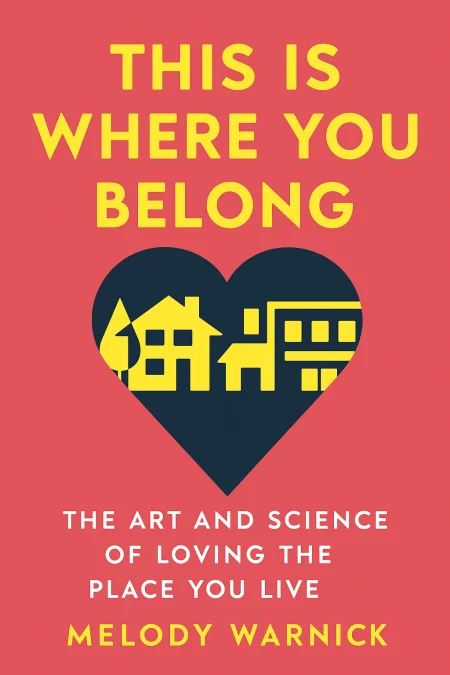
This Is Where You Belong
The Art and Science of Loving the Place You Live
Book Edition Details
Summary
When Melody Warnick found herself uprooted for the sixth time, this time to Blacksburg, Virginia, the question of belonging tugged at her heart. Rather than passively waiting for the town to fit her dreams, she embarked on a daring quest: to fall in love with her new home. "This Is Where You Belong" chronicles her journey through the kaleidoscope of place attachment, exploring how communities transform from mere dots on a map to the epicenters of our lives. Warnick's adventures reveal the alchemy of placemaking, a blend of neighborly dining, small-town celebrations, and the vibrant heartbeat of local life. Through her lens, discover how the seemingly mundane aspects of a town can stir a profound sense of home. As Melody experiments with these ideas in Blacksburg, she challenges us to look around with fresh eyes and find that the place we reside might just be where our hearts belong.
Introduction
Picture this: it's 1950, and most Americans live within walking distance of where they were born. Neighbors know each other's names, children play on the same streets their parents once roamed, and the corner drugstore owner remembers three generations of the same family. Fast forward to today, and the average American will move nearly twelve times in their lifetime, chasing jobs, dreams, and the elusive promise that happiness lies just one zip code away. This transformation from a nation of stayers to a country of perpetual movers represents one of the most profound social shifts in American history. Through this lens, we discover how our relationship with place shapes everything from our health and happiness to our children's futures and our communities' prosperity. The story reveals three critical insights: why the post-war mobility revolution fundamentally altered American community life, how the commodification of place created a crisis of belonging that persists today, and what the emerging rediscovery movement teaches us about rebuilding authentic connections to where we live. This exploration speaks to anyone who has ever wondered whether they're living in the right place, parents concerned about the impact of frequent moves on their children, and communities struggling to retain residents in an increasingly mobile world. It's ultimately a story about rediscovering the art of loving where you live, even when that place isn't perfect.
Post-War Mobility Revolution: From Rooted Communities to Corporate Transfers (1950s-2000s)
The great American migration story begins in the post-war boom of the 1950s, when unprecedented prosperity and the GI Bill unleashed a generation of newly mobile families. What started as opportunity-driven movement gradually evolved into something more complex: a cultural expectation that Americans should be willing to pull up stakes in pursuit of better jobs, better schools, or simply better lives. The interstate highway system, suburban development, and the rise of national chains created a landscape where one place looked increasingly like another, making mobility seem both easier and more necessary. By the 1970s, corporate America had institutionalized this mobility, routinely transferring employees across the country and expecting families to follow without question. The numbers tell a striking story: while in 1950 most Americans lived within fifty miles of their birthplace, by 2000 the average person could expect to move eleven times in their lifetime. This represented a fundamental shift from a society organized around extended family networks and multi-generational community ties to one built on nuclear families and professional networks. Yet this era of rootless mobility came with hidden costs that only became apparent decades later. Children who moved frequently showed higher rates of behavioral problems and struggled more with forming lasting friendships. Adults reported feeling increasingly disconnected from their communities, even as they gained access to better career opportunities. The social fabric that had once held American communities together began to fray, replaced by a more individualistic but also more isolated way of life. By the early 2000s, researchers began documenting what they called "place attachment deficit disorder" - a condition where constant moving prevented people from developing the deep connections to place that foster both individual well-being and community resilience. The very mobility that had once symbolized American freedom was beginning to feel more like a trap, leaving millions of families perpetually searching for a home they could never quite find.
The Commodification Crisis: When Places Became Interchangeable Products (1980s-2010s)
The transformation of American communities accelerated dramatically in the 1980s and 1990s as globalization and economic restructuring turned places into commodities to be bought, sold, and discarded based on market forces. Small towns that had anchored families for generations found themselves competing not just with neighboring communities, but with cities on the other side of the world. When factories closed and moved overseas, entire communities faced existential crises that no amount of local pride could solve. This commodification of place was perhaps most visible in the rise of big-box retail and chain restaurants that promised convenience and low prices while systematically destroying the local businesses that had given communities their unique character. Main Streets across America became ghost towns as Walmart and McDonald's relocated commerce to highway strips that could have been anywhere. The result was a landscape of "anyplace" - communities so generic that residents struggled to explain what made their town special or worth staying in. Real estate became another driver of placelessness, as housing developments marketed lifestyle brands rather than actual communities. Subdivisions with names like "Heritage Oaks" or "Colonial Manor" promised connection to place while actually severing residents from any authentic local history or culture. Homeowners found themselves living in communities designed for maximum marketability rather than genuine livability, surrounded by neighbors they might never meet. The psychological impact of this commodification was profound. When places became interchangeable products rather than irreplaceable homes, people began to relate to their communities as consumers rather than citizens. The question shifted from "How can I contribute to this place?" to "What can this place do for me?" This consumer mindset made it easier to leave when a community failed to meet expectations, but it also made it harder to develop the deep investment in place that creates truly thriving communities.
The Rediscovery Movement: Learning to Love Where You Live (2000s-Present)
By the early 2000s, a quiet revolution was beginning to emerge as Americans started questioning the costs of constant mobility. This rediscovery movement wasn't organized by any central authority, but rather grew organically from individuals and families who had grown tired of the endless cycle of moving and searching. They began to ask a radical question: what if the problem wasn't finding the perfect place, but learning to love the place where you already are? The movement gained momentum through books, blogs, and grassroots organizations that challenged the assumption that happiness required geographic mobility. Researchers began documenting the benefits of "place attachment" - the deep emotional connection people develop with their communities over time. Studies showed that people with strong place attachment were healthier, happier, and more civically engaged than their more mobile counterparts. Children who grew up in stable communities showed better academic outcomes and stronger social skills. This research coincided with a growing awareness of the environmental costs of American mobility. The carbon footprint of constantly moving households, the waste generated by disposable consumer culture, and the destruction of natural landscapes for suburban development all contributed to a sense that the mobile lifestyle was ultimately unsustainable. Young families began choosing walkable neighborhoods over sprawling suburbs, even when it meant accepting smaller homes or longer commutes. The rediscovery movement also embraced the power of intentional community building. Rather than waiting for the perfect place to appear, people began actively working to improve the places where they lived. Community gardens sprouted in vacant lots, neighbors organized block parties and walking groups, and local business districts experienced renaissance as residents committed to shopping locally. The movement represented a shift from passive consumption of place to active creation of community.
Building Attachment Through Action: Small Acts That Transform Communities
The final phase of America's relationship with place has been characterized by the recognition that loving where you live is not a passive feeling but an active practice. This realization has spawned countless experiments in community building, from tactical urbanism projects that transform underused spaces into community assets, to "buy local" campaigns that keep dollars circulating in local economies. The common thread is the understanding that place attachment grows through engagement, not just residence. Research has identified specific behaviors that foster place attachment: walking or biking instead of driving, shopping at locally-owned businesses, getting to know neighbors, volunteering for community organizations, and spending time in local natural spaces. These activities create what psychologists call "place dependence" - a practical reliance on local resources that gradually deepens into emotional attachment. The more ways people find to meet their needs locally, the more invested they become in their community's success. Technology has played an unexpected role in this community building renaissance. Social media platforms allow neighbors to connect more easily, apps help people discover local events and businesses, and online tools enable grassroots organizing around community issues. Rather than isolating people in virtual worlds, these technologies have often served to strengthen real-world community connections by making it easier to coordinate face-to-face activities and local initiatives. The most successful community building efforts have recognized that place attachment cannot be manufactured or imposed from above, but must grow organically from residents' own experiences and relationships. Cities that have invested in creating opportunities for positive community experiences - through festivals, farmers markets, public art projects, and improved public spaces - have seen measurable increases in resident satisfaction and retention. The key insight is that communities are not just physical spaces but ongoing social creations that require active participation to thrive.
Summary
The American journey from rootedness to mobility and back toward intentional place attachment reveals a fundamental truth about human nature: we are creatures who need to belong somewhere, even in an age of unprecedented mobility. The decades-long experiment with treating communities as interchangeable commodities has taught us that while mobility can provide opportunities, it cannot provide meaning. That deeper satisfaction comes from the patient work of building connections to people and places over time. The story offers three crucial insights for navigating our mobile age. First, the quality of our relationship with place matters more than the objective qualities of the place itself - a modest town where we feel deeply connected will make us happier than a prestigious city where we remain isolated. Second, place attachment is not something that happens to us but something we actively create through daily choices about how we spend our time and money. Finally, the health of our communities depends not on attracting the perfect residents but on helping current residents fall in love with where they already live. These lessons point toward a more sustainable and satisfying way of life that balances the benefits of mobility with the deep human need for rootedness. Whether we stay in one place for decades or move frequently for work, we can choose to engage deeply with our communities, support local businesses, and invest in relationships with neighbors. In doing so, we not only improve our own well-being but contribute to the kind of places that future generations will want to call home.
Related Books
Download PDF & EPUB
To save this Black List summary for later, download the free PDF and EPUB. You can print it out, or read offline at your convenience.
By Melody Warnick
