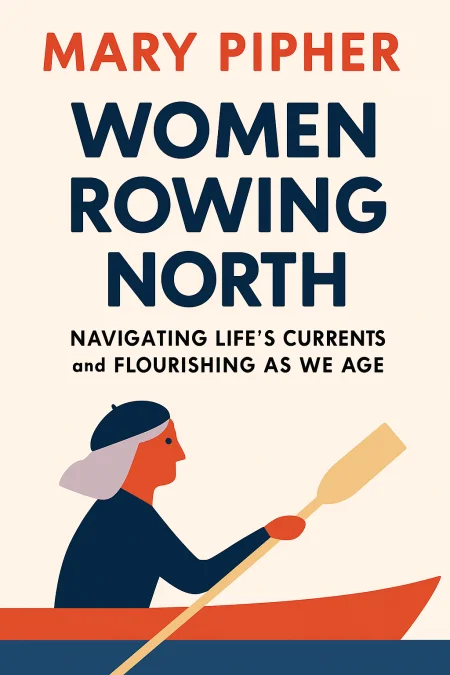
Women Rowing North
Navigating Life’s Currents and Flourishing As We Age
Book Edition Details
Summary
In the twilight of life, where whispers of ageism and the echoes of misogyny loom, Mary Pipher offers a luminous guide for women navigating the uncharted waters of their later years. "Women Rowing North" is not just a book; it's a beacon for those seeking wisdom amidst the storm. Through her rich tapestry of personal anecdotes and stories from other resilient women, Pipher explores how aging can transform into a period of profound joy and authenticity. With a keen psychological lens and a heartfelt touch, she illuminates the path to emotional resilience, empowering women to embrace their sixties and seventies with grace and gratitude. Here lies a celebration of life's later chapters, where the seasoned heart finds a renewed sense of purpose and community, proving that the journey northward is as transcendent as it is beautiful.
Introduction
Mary Pipher sits in her neighborhood recreation center locker room, observing a remarkable transformation. Unlike the younger women at her previous gym who hid their bodies and discussed their anxieties, the older women here walk around unselfconsciously, sharing jokes and planning adventures. Their faces, marked by decades of joy and suffering, are open and awake to the moment. This scene captures something profound about the journey into later life—a paradox where physical changes coincide with emotional liberation. Pipher, a renowned psychologist who spent her career understanding women's experiences, now turns her lens toward a demographic often misunderstood and undervalued: women navigating their sixties and seventies. These are the women crossing into what she calls the "new stretch of river," facing unprecedented challenges while discovering unexpected gifts. Through her exploration, we encounter women who are not merely surviving aging but transforming it into a period of authenticity, wisdom, and surprising joy. From this rich tapestry of stories and insights, readers will discover how to build resilience in the face of loss and change, how to cultivate meaningful relationships that sustain us through difficult times, and how to find transcendence and beauty even in life's most challenging moments. This is not a story of decline, but of women learning to row north toward the light.
Challenges of the Journey: Aging and Cultural Transformation
The transition into later life resembles entering foreign territory with an unknown language. At sixty-eight, Emma watches her reflection change daily, while her friend Pia compulsively shows visitors photographs of her younger self, desperate to prove she was once beautiful. These moments capture the disorientation many women feel as they confront a culture that renders them invisible or ridiculous. American society offers older women a peculiarly harsh reception. Birthday cards mock their sexuality and mental faculties, while media representation virtually erases them from view. The Geena Davis Institute found that women over forty have essentially vanished from Hollywood, reinforcing a message that aging women have nothing valuable to offer. This cultural narrative creates what Pipher calls "a social disease"—the systematic devaluation of women who have accumulated decades of wisdom and experience. Yet the challenges extend beyond cultural attitudes to profound physical and emotional adjustments. Bodies that once felt reliable now require constant negotiation. Sylvia struggles with arthritis pain while caring for her grandchildren, her energy flagging under the weight of responsibilities she never expected to carry. Meanwhile, Kestrel confronts her mother's cancer diagnosis, forcing her to navigate healthcare systems and face mortality in ways that shatter her carefully constructed emotional defenses. The women who thrive during this transition share a common trait: they refuse to accept limiting narratives about their worth or potential. Like the legendary Athabaskan women who survived abandonment by their tribe through determination and resourcefulness, today's older women are learning to claim their power. They educate others about ageist stereotypes, advocate for better policies, and most importantly, support each other through the inevitable challenges that arise when crossing this crucial border in their lives.
Travel Skills: Building Resilience and Authentic Living
The art of successful aging requires developing what Pipher calls "travel skills"—specific capabilities that help navigate the complexities of later life. Central among these is deep self-understanding, the ability to distinguish between automatic reactions and authentic responses. Emma discovers this through therapy, learning to recognize her tendency to sacrifice her own needs for others' approval. After decades of saying yes to every request, she finally experiences the liberating power of saying no. Building a good day becomes both an art and a science for women in this life stage. It requires careful attention to energy management, emotional regulation, and the cultivation of small daily pleasures. Sylvia learns to rate her pain on a scale and schedule "red ink appointments" for her own needs—swimming, journaling, and attending her women's group. These seemingly simple acts transform her from a woman overwhelmed by circumstances into someone who actively creates her own well-being. The skill of perspective-taking emerges as crucial for emotional survival. When faced with the question "Is this brain cancer?" most problems shrink to manageable proportions. Women learn to break overwhelming tasks into one-hour segments and focus on short-term goals when long-term planning feels impossible. They develop mantras like "It's not time to worry yet" and practice the art of living in noticed time, where a grandson's laugh or the sight of morning light becomes a portal to contentment. Perhaps most importantly, these women master the creation of meaning through intentional choices. They learn to distinguish between wants and needs, develop personal definitions of wealth that extend far beyond financial resources, and craft narratives that honor both their struggles and their growth. This isn't about positive thinking or denial—it's about the hard-won wisdom of women who have learned to find beauty and purpose regardless of their circumstances.
The People on the Boat: Relationships and Community
No woman navigates the challenges of aging alone, and Pipher emphasizes that relationships form the essential lifeboat that keeps us afloat during turbulent times. Her thirty-year camping group demonstrates how women's friendships evolve into something sacred—a space where authentic emotions can be shared, healing ceremonies created, and practical support offered without judgment. When Soledad faces her husband's terminal illness alongside her own lupus diagnosis, her friends respond with a ritual of healing objects and the gift of a new name: Courage. Family relationships, despite their complications, provide irreplaceable continuity and meaning. Kestrel discovers this during her mother's final summer, when a family reunion reveals that her brothers and their children offer something she hadn't realized she needed: belonging. The challenging dynamics she remembered from childhood have been transformed by time and shared love, creating new possibilities for connection and healing. Long-term partnerships face their own navigation challenges as couples renegotiate roles and expectations. Emma and Chris have learned to let small irritations pass while addressing larger issues with care and humor. Their decades together have taught them when to speak and when to remain silent, how to support each other through difficulties, and most importantly, how to see beyond current frustrations to the enduring love that sustains them through change. The relationship that often brings the purest joy is with grandchildren, who see their grandmothers not as aged women but as sources of unconditional love and fascinating stories. These relationships offer older women the gift of being needed and valued while providing children with the security of being deeply known and accepted. Through activities both simple and profound—nature walks, cookie baking, philosophical conversations—grandmothers pass on family values and create memories that will sustain future generations. The reciprocal love in these relationships reminds everyone involved that connection transcends age and circumstance.
The Northern Lights: Wisdom and Transcendence
The final reward of this challenging journey toward later life is the possibility of achieving what Pipher calls authenticity—the "radiant sovereign self" that emerges when fear gives way to wholeness. This transformation doesn't happen automatically; it requires the courage to shed false selves acquired in childhood and the wisdom to embrace one's true nature. For Kestrel, authenticity means learning to trust and be vulnerable. For Emma, it involves finally listening to her own voice rather than constantly accommodating others' needs. The long view of time becomes a source of profound comfort and perspective. Women who have lived through multiple life stages can see themselves across decades—as young girls, new mothers, career builders, and now as elders. This perspective allows them to understand which qualities endure and which are merely temporary, providing a sense of continuity that transcends physical changes. They can trace the influences that shaped them while recognizing their power to choose how they respond to current circumstances. Most mysteriously and wonderfully, many women in this life stage discover an increased capacity for what can only be called bliss—moments of transcendent joy that arise from the simplest experiences. Emma feels such a moment watching her family by a mountain lake, suddenly experiencing herself as being in the heart of the universe. These experiences, perhaps made possible by the accumulated wisdom of years and the proximity of mortality, represent the northern lights of later life—illuminating beauty that emerges from darkness. The capacity for awe and wonder doesn't diminish with age but often intensifies, as if approaching the end of life opens our eyes to its extraordinary beauty. Whether watching grandchildren play, sitting with a dying spouse, or simply observing light filter through leaves, these women discover that every moment contains the potential for profound appreciation. This isn't consolation for losses endured but genuine transcendence—the flowering of consciousness that comes from having truly lived.
Summary
Mary Pipher's exploration of women's later years reveals a fundamental truth: aging is not simply about decline but about transformation into something deeper and more authentic than youth could ever achieve. The women who navigate this passage successfully do so not by denying its challenges but by developing the skills to meet them with resilience, wisdom, and surprising joy. From their experiences, we learn that happiness in later life requires intention and effort—the conscious choice to build good days, maintain meaningful relationships, and create narratives that honor both struggle and growth. Perhaps most importantly, we discover that the capacity for growth, love, and wonder doesn't diminish with age but can actually expand, offering possibilities for transcendence that younger selves could never imagine. These insights offer hope not just to women approaching this life stage but to anyone seeking to understand how wisdom and authenticity can emerge from life's greatest challenges.
Related Books
Download PDF & EPUB
To save this Black List summary for later, download the free PDF and EPUB. You can print it out, or read offline at your convenience.
By Mary Pipher
