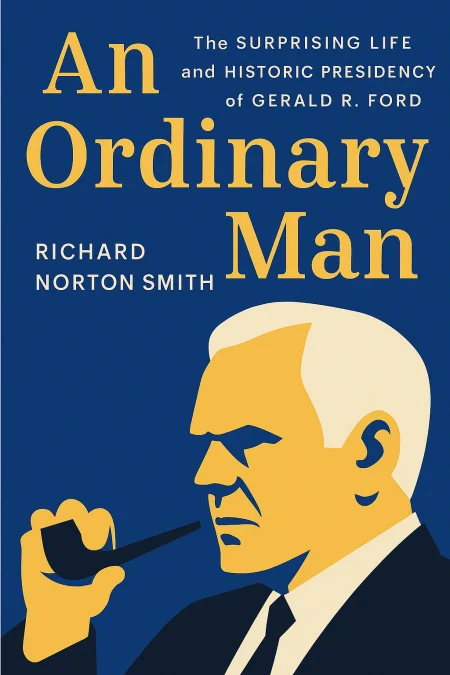
An Ordinary Man
The Surprising Life and Historic Presidency of Gerald R. Ford
Book Edition Details
Summary
A figure often overshadowed by the drama of his times, Gerald R. Ford emerges in Richard Norton Smith's masterful biography as a leader of quiet strength and enduring influence. This narrative reshapes our view of the 38th president, delving into his formative years in Michigan and his steadfast partnership with Betty Bloomer. Smith peels back layers to reveal a presidency that deftly navigated America's deepest crises, from constitutional turmoil to economic despair, with a grace that history has only recently begun to recognize. Ford's legacy as a bridge between political eras and his foresight in global affairs, particularly his role in economic reform and the Helsinki Accords, mark him as a pivotal force in shaping modern America. Through incisive storytelling and unparalleled research, this biography offers an enlightening portrait of a man whose unassuming nature belied the magnitude of his impact.
Introduction
In the sweltering summer of 1974, as Richard Nixon's presidency crumbled under the weight of Watergate, America faced its gravest constitutional crisis since the Civil War. When Gerald Ford took the oath of office on August 9, 1974, he became the only person in history to serve as president without being elected to either the presidency or vice presidency. Yet this accidental leader would guide the nation through some of its most turbulent years, making decisions that would test the very foundations of American democracy. Ford's remarkable journey illuminates three profound questions that resonate powerfully today: How does a democracy heal itself after betrayal by its highest leaders? What happens when moral courage collides with political survival? And can institutional integrity triumph over partisan warfare? Through Ford's eyes, we witness the delicate balance between pragmatic governance and principled leadership, as he navigated everything from the controversial Nixon pardon to the final collapse of South Vietnam, from economic stagflation to Cold War diplomacy that would ultimately help end the Soviet empire. This story speaks to political leaders grappling with questions of accountability and forgiveness, citizens wondering whether principled governance remains possible in polarized times, and anyone seeking to understand how character can matter more than charisma in moments of national crisis. Ford's presidency reminds us that sometimes the most transformative leaders are those who restore faith rather than revolutionize systems, and that true statesmanship often requires sacrificing one's own political future for the greater good.
From Grand Rapids to Capitol Hill: Building Character Through Service (1913-1973)
Gerald Ford's early life in Grand Rapids, Michigan, forged the character that would later steady a wounded nation. Born Leslie King Jr. in 1913, he was rescued from an abusive father by his courageous mother Dorothy, who fled to Michigan and married Gerald Ford Sr., a paint salesman who gave the future president both his name and his values. In that modest household, young Jerry learned that family was built through love and commitment, not just blood, and that character mattered more than circumstances. At the University of Michigan, Ford excelled both academically and athletically, starring as center on two national championship football teams. But his most formative experience came when he stood up for his Black teammate Willis Ward, who was benched due to racial prejudice. Ford considered boycotting the game in protest, demonstrating the moral courage that would define his later career. This early lesson in standing up for what's right, regardless of personal cost, would echo throughout his six decades of public service. After Yale Law School and naval service in World War II, Ford returned to Grand Rapids with political ambitions rooted in principled Republican leadership. His 1948 congressional campaign against isolationist incumbent Bartel Jonkman established the template for Ford's political philosophy: internationalist in foreign policy, fiscally conservative but pragmatic in domestic affairs, and always willing to work across party lines. For twenty-five years in the House, Ford built a reputation as a man of his word, someone who could be trusted even by political opponents. Ford's rise to House Minority Leader in 1965 reflected his colleagues' recognition of his unique combination of ambition and integrity. He challenged the old guard not through personal attacks but by offering a positive vision of Republican governance. His leadership style emphasized preparation, fairness, and building consensus rather than scoring political points. These qualities, along with his unquestioned integrity, made him the natural choice when President Nixon needed a vice president untainted by Watergate, setting the stage for his unexpected ascension to the presidency.
Constitutional Crisis and Unexpected Succession: Watergate's Aftermath (1973-1974)
The Watergate crisis thrust Ford into the most improbable political succession in American history. When Vice President Spiro Agnew resigned in disgrace in October 1973, Nixon faced the unprecedented challenge of choosing a replacement under the Twenty-fifth Amendment. Ford's selection reflected not just his legislative experience, but his unassailable reputation for honesty in an administration increasingly defined by deception and corruption. As vice president, Ford walked a treacherous tightrope, maintaining loyalty to Nixon while privately growing alarmed at the mounting evidence of presidential wrongdoing. His congressional colleagues watched anxiously as their former leader navigated between institutional loyalty and personal integrity. Ford's careful public statements during this period revealed a man struggling to reconcile his respect for the presidency with his commitment to truth and constitutional governance. The final days of the Nixon presidency tested Ford's character in ways he never could have imagined. When Chief of Staff Alexander Haig approached him with what seemed like an offer to trade a pardon for Nixon's resignation, Ford's instinctive rejection revealed the moral clarity that would define his presidency. He understood that the office he was about to inherit had been damaged not just by Nixon's crimes, but by the very appearance of deals and compromises that placed politics above principle. On August 9, 1974, as Nixon's helicopter lifted off from the White House lawn, Ford faced a moment that would have overwhelmed a lesser man. Instead, he drew strength from the simple values learned in Grand Rapids: tell the truth, do your duty, and trust the American people to respond to honest leadership. His first words as president captured both the nation's exhaustion and its desperate hope for renewal: "Our long national nightmare is over." In that moment, Ford transformed from an accidental president into the leader America desperately needed.
Presidential Leadership Through National Trauma: The Pardon Decision and Healing (1974-1977)
Ford's presidency began with a burst of hope as Americans embraced their new leader's refreshing candor and accessibility. He opened the White House to ordinary citizens, cooked his own breakfast, and brought a sense of normalcy to an institution that had become isolated and imperial. Betty Ford's openness about her struggles with breast cancer and addiction further humanized the First Family, showing that even presidents faced the same challenges as other Americans. But Ford's defining moment came just thirty days into his presidency with his decision to pardon Richard Nixon. The political firestorm was immediate and devastating, with critics charging that a secret deal had been struck. Ford's approval ratings plummeted overnight, and many of his closest advisors urged him to reconsider. Yet Ford held firm, believing that the nation's healing required moving beyond the endless litigation and recrimination that would have followed Nixon's prosecution. As he later explained, the country needed to focus on its pressing problems rather than remain mired in the past. Ford's domestic and foreign policy achievements often went unnoticed amid the political turbulence surrounding the pardon. He battled inflation through fiscal discipline, began the deregulation movement that would transform the American economy, and maintained steady leadership during the final collapse of South Vietnam. His handling of the Mayaguez incident demonstrated American resolve while avoiding unnecessary escalation. The Helsinki Accords, though criticized at the time as legitimizing Soviet control of Eastern Europe, actually planted seeds of freedom by establishing human rights principles that dissidents would later use to challenge Communist rule. The 1976 election campaign revealed both Ford's political limitations and his essential decency. His narrow loss to Jimmy Carter reflected not just the burden of Watergate and economic troubles, but also his inability to articulate a compelling vision for America's future. Yet his gracious concession and smooth transition to his successor demonstrated the institutional values that had guided his entire career. Ford left office having restored dignity to the presidency and faith in the peaceful transfer of power, achievements that would loom larger with each passing year.
Legacy of Integrity: Post-Presidential Vindication and Democratic Renewal (1977-2006)
Ford's post-presidential years revealed the enduring power of his example and brought increasing recognition of his contributions to American democracy. Initially stung by his 1976 defeat, he gradually embraced his role as elder statesman, serving on corporate boards while maintaining his commitment to public service. His friendship with Jimmy Carter, forged during difficult times, became a model for how former presidents could transcend partisan differences in service of the national interest. The passage of time vindicated many of Ford's most controversial decisions. The end of the Cold War validated his patient approach to Soviet relations, while the Helsinki Accords were recognized as crucial to the peaceful revolutions that swept Eastern Europe. More dramatically, the Clinton impeachment crisis of 1998-1999 led many Americans to reconsider Ford's pardon of Nixon, seeing it as an act of statesmanship rather than political expedience. The prolonged constitutional crisis that Ford had sought to avoid became a cautionary tale about the wisdom of his decision. Ford's personal evolution continued throughout his later years, as he became increasingly liberal on social issues, supporting abortion rights and gay marriage with a consistency that sometimes put him at odds with his own party. This progression reflected not political calculation but genuine growth, as Ford applied his fundamental belief in human dignity to changing social circumstances. His willingness to evolve while maintaining core principles demonstrated the kind of principled flexibility that effective governance requires. The ultimate vindication came in 2001 when the John F. Kennedy Library awarded Ford its Profile in Courage Award for the Nixon pardon. Senator Ted Kennedy's presentation acknowledged that time had clarified past events and revealed Ford's wisdom. Ford's death in 2006 prompted a national reassessment of his presidency, with historians and political leaders across the spectrum praising his integrity, judgment, and service during one of America's most difficult periods. His legacy reminds us that sometimes the most important presidential quality is simply being trustworthy.
Summary
Gerald Ford's remarkable journey from small-town congressman to accidental president illuminates the enduring tension between moral leadership and political survival in American democracy. Throughout his brief but consequential presidency, Ford consistently chose what he believed was right over what was popular, from the Nixon pardon to his patient Cold War diplomacy to his commitment to institutional norms over partisan advantage. This pattern reveals the central challenge of democratic leadership: how to balance principle with pragmatism while maintaining the trust of the governed. Ford's experience offers three crucial lessons for contemporary politics. First, that healing national divisions requires leaders willing to sacrifice their own political interests for the common good, even when such sacrifice seems politically suicidal. Second, that institutional integrity and respect for constitutional norms matter more than short-term political victories or partisan warfare. Third, that character and competence can matter more than charisma and ideology in times of genuine crisis, when citizens yearn for steady leadership rather than revolutionary change. Perhaps most importantly, Ford's presidency demonstrates that democracy's strength lies not in the perfection of its leaders, but in the resilience of its institutions and the decency of those who serve them. In an era of increasing polarization and declining trust in government, Ford's example reminds us that public service at its best is about stewardship rather than power, about healing rather than winning, and about leaving the country better than you found it, even if history's judgment must wait for future generations to render. His legacy suggests that in times of crisis, America has been blessed with leaders whose greatest strength was their fundamental decency and unwavering commitment to democratic values over personal ambition.
Related Books
Download PDF & EPUB
To save this Black List summary for later, download the free PDF and EPUB. You can print it out, or read offline at your convenience.
By Richard Norton Smith
