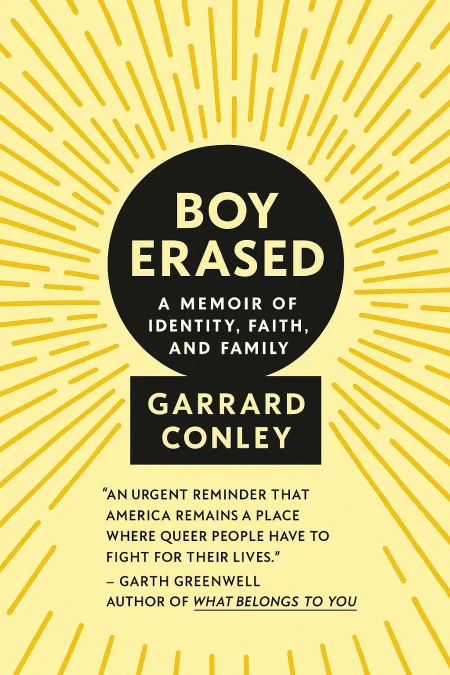
Boy Erased
A Memoir of Identity, Faith, and Family
Book Edition Details
Summary
In the heart of small-town Arkansas, where faith is as ingrained as the red dirt roads, Garrard Conley grapples with a profound inner turmoil. As the son of a Baptist pastor, his world is upended when his secret is exposed, and he stands at a crossroads between his identity and his family’s beliefs. Enrolled in a church-sanctioned conversion therapy program, Garrard is promised redemption at the cost of his true self. Yet, amidst the cold rigidity of scripture-laden therapy, a spark of resilience ignites. "Boy Erased" is a piercing memoir of survival and self-discovery, where the journey through the shadows of dogma reveals a light of understanding and love that defies the odds. Witness the raw courage it takes to reclaim one's soul against a backdrop of unwavering devotion and societal expectation.
Introduction
In the summer of 2004, nineteen-year-old Garrard Conley found himself at a crossroads that would define the rest of his life. Standing at the entrance of Love in Action, a Christian conversion therapy facility in Memphis, Tennessee, he carried with him the weight of his family's expectations, his faith, and a secret that threatened to tear apart everything he had ever known. The son of a Baptist preacher in small-town Arkansas, Conley was about to embark on a harrowing two-week journey that would challenge not only his understanding of sexuality and faith, but his very sense of self. This is the story of a young man caught between two worlds: the fundamentalist Christian community that raised him and the emerging awareness of his own identity. Through Conley's eyes, we witness the devastating impact of conversion therapy, the complex dynamics of family love and religious conviction, and the extraordinary courage required to choose authenticity over acceptance. His journey reveals the profound resilience of the human spirit and offers insights into the ongoing struggle for LGBTQ+ rights in America. From this deeply personal narrative, readers will discover the true cost of denying one's authentic self, the power of unconditional love, and the possibility of healing even the deepest wounds inflicted by those who claim to act out of love.
The Breaking Point: Discovery and Denial
The unraveling began with a phone call. David, a college acquaintance who had sexually assaulted Conley months earlier, contacted his parents to reveal their son's sexuality, framing it as concern for the family's spiritual well-being. For the Conley family, deeply rooted in Arkansas Baptist tradition, this revelation struck like lightning in their carefully constructed world. Garrard's father was on the verge of ordination as a Baptist minister, and his mother had built her identity around being the perfect preacher's wife. The news threatened not just their family unity, but their entire social standing in their conservative community. In the days following the revelation, the family home became a battlefield of emotions. Conley's mother physically ill from shock, his father torn between love for his son and his religious convictions. The young man who had once been the pride of his family now felt like a walking catastrophe, watching his parents grapple with a reality that challenged everything they believed about God, family, and righteousness. The silence between them grew heavy with unspoken fears and desperate hopes for a solution that might restore their former happiness. As winter turned to spring, the family's search for answers led them deeper into the world of Christian conversion therapy. They consulted with pastors, therapists, and ex-gay counselors, each conversation adding another layer to their growing belief that Garrard's sexuality was not just wrong, but curable. The young man found himself caught in a web of self-doubt and religious terror, wondering if the feelings he had tried so hard to suppress were indeed a form of spiritual sickness that could be healed through faith and determination. The decision to enroll in Love in Action emerged from this climate of desperation and hope. For Conley's parents, it represented their last chance to save their son's soul and preserve their family's future. For Garrard, it became a final attempt to reconcile his faith with his identity, even as doubt began to creep into his heart about whether such reconciliation was possible or even necessary.
Love in Action: Inside Ex-Gay Therapy
The Love in Action facility in Memphis bore little resemblance to a traditional treatment center. Housed in a nondescript strip mall, the program operated with the clinical efficiency of a medical facility combined with the fervor of a religious revival. Upon arrival, Conley was immediately stripped of personal belongings that might contain "False Images" anything that could be considered inconsistent with traditional masculine identity. His journal, filled with creative writing, was confiscated and destroyed, severing his connection to one of his most cherished forms of self-expression. The daily routine at Love in Action was designed to break down participants' sense of self and rebuild them according to the program's vision of biblical masculinity. Group therapy sessions focused on uncovering childhood trauma that supposedly caused homosexual feelings. Participants were required to create detailed genograms mapping their families' sins across generations, identifying patterns of addiction, abuse, and dysfunction that could explain their sexual orientation. The message was clear: homosexuality was not an innate characteristic but a learned response to family pathology. John Smid, the program's charismatic director, preached a gospel of transformation through confession and submission. Under his guidance, participants engaged in role-playing exercises, confronting imaginary fathers in empty chairs and screaming out years of supposed resentment and unmet needs for masculine affirmation. The atmosphere was charged with religious fervor and psychological manipulation, as counselors pushed participants to admit to traumas they might not have experienced and to embrace narratives that explained away their authentic feelings. The program's methodology was both sophisticated and crude, combining elements of Alcoholics Anonymous twelve-step programs with biblical literalism and amateur psychology. Participants were taught to view their sexuality as an addiction requiring constant vigilance and suppression. They learned to police their own behavior and that of others, creating an environment of mutual surveillance and judgment that made genuine healing impossible and authentic relationships nearly unthinkable.
The Lie Chair: Confronting False Truths
The most traumatic aspect of Conley's experience came through a technique called the "Lie Chair," where participants were forced to confront empty chairs representing their fathers while confessing their deepest resentments and supposed psychological wounds. When Conley's turn came, he found himself unable to manufacture the anger and trauma that the program demanded he feel. His relationship with his father, while complex, was fundamentally loving, and he could not bring himself to perform the emotional theatrics that the counselors insisted were necessary for his healing. This refusal to conform to the program's narrative marked Conley as a problem case. Staff members accused him of hiding his true feelings and resisting the therapeutic process. The pressure to conform intensified, with counselors suggesting that his inability to express rage toward his father indicated a deeper level of psychological damage and spiritual rebellion. The young man found himself caught between his authentic experience and the program's demand that he fit into their predetermined model of homosexual development. The breaking point came when Conley was confronted by staff members who insisted he was deceiving himself and others about his emotional state. Rather than succumb to their pressure to manufacture false memories and emotions, he made a choice that would change the trajectory of his life. Standing before the group, shaking with anxiety but determined to preserve his integrity, he refused to participate in what he recognized as psychological manipulation disguised as spiritual healing. His decision to walk away from the Lie Chair represented more than just resistance to a particular exercise; it was a rejection of the entire framework that sought to remake him in the image of someone else's understanding of righteousness. In that moment, surrounded by the expectations of counselors, fellow participants, and his own desperate desire to please his family, Conley chose truth over acceptance, authenticity over belonging.
Choosing Life: The Path to Self-Liberation
The aftermath of Conley's departure from Love in Action was both immediate and long-lasting. His mother, witnessing her son's psychological distress during the ride home, made the crucial decision to end his participation in conversion therapy. This choice required tremendous courage, as it meant abandoning the hope that had sustained them through months of anguish and accepting an uncertain future that challenged their fundamental beliefs about faith, family, and sexuality. The journey toward healing and self-acceptance proved far more complex than simply leaving the program. Conley struggled with depression, anxiety, and a profound sense of spiritual displacement. The God who had once been his constant companion felt distant and silent, leaving him to navigate questions of identity and purpose without the religious framework that had previously structured his entire worldview. Relationships with family members remained strained as they all grappled with the disconnect between their love for each other and their conflicting beliefs about morality and truth. Years of therapy, education, and personal growth gradually helped Conley reclaim his sense of self and build a life that honored both his sexuality and his complex relationship with faith. He learned to distinguish between the punitive religion of his youth and the possibility of spirituality that embraced rather than condemned his authentic identity. This process required not just accepting himself, but also finding the strength to forgive those who had participated in his attempted transformation, recognizing that they too were products of a system that prioritized conformity over compassion. The ultimate victory was not just personal but literary. By transforming his experience into art, Conley created meaning from suffering and offered hope to others facing similar struggles. His story became a testament to the resilience of the human spirit and a powerful indictment of practices that seek to cure what is not diseased, revealing the true cost of denying the beautiful complexity of human identity in all its forms.
Summary
Garrard Conley's journey from the suffocating confines of conversion therapy to the freedom of self-acceptance reveals that the greatest act of faith is sometimes the courage to trust our own authentic experience over the expectations of others, even those we love most deeply. His story demonstrates that healing begins not with changing ourselves to fit others' definitions of righteousness, but with embracing the truth of who we are and finding the strength to live authentically despite the cost. From his experience, we learn that real transformation comes not from denying our nature but from integrating all aspects of ourselves into a whole that honors both our deepest convictions and our honest experience of the world. This narrative offers hope to anyone who has ever felt torn between belonging and authenticity, showing that it is possible to build a meaningful life that refuses to sacrifice truth for acceptance. Conley's journey speaks especially to those navigating conflicts between religious faith and personal identity, offering a model of resilience and self-compassion that transcends the specific circumstances of his story to address the universal human need for love, acceptance, and the freedom to be authentically ourselves.
Related Books
Download PDF & EPUB
To save this Black List summary for later, download the free PDF and EPUB. You can print it out, or read offline at your convenience.
By Garrard Conley
