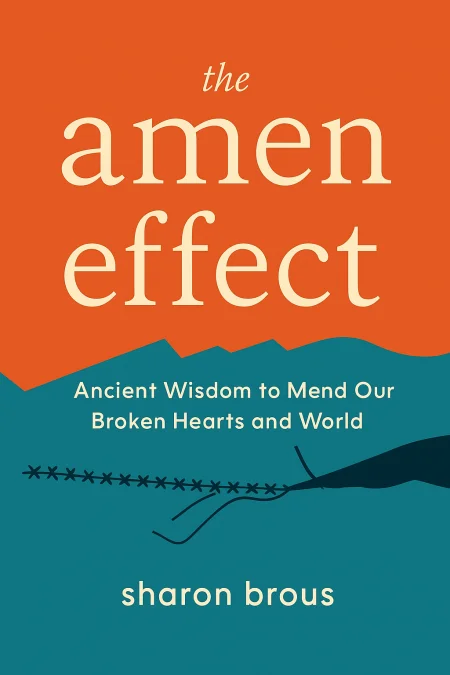
The Amen Effect
Ancient Wisdom to Mend Our Broken Hearts and World
Book Edition Details
Summary
In an era where screens and solitude often overshadow real human interaction, Sharon Brous, a visionary American rabbi, offers a heartfelt manifesto for rekindling our innate longing for community. "The Amen Effect" delves into the transformative power of shared experiences—whether in joy, sorrow, or simple presence—to bridge the chasms of alienation. Drawing from her dynamic sermons and rich storytelling, Brous weaves ancient Jewish teachings with modern scientific insights, crafting a blueprint for societal healing through authentic connection. This book is not just a call to gather; it’s an invitation to rediscover our shared humanity and moral imperative to stand by one another. Let Brous guide you to embrace vulnerability, celebrate unity, and build a world defined by compassion and care.
Introduction
In the midst of a crowded emergency room, a young mother holds her fevering child while strangers rush past, each absorbed in their own crisis. Yet in that moment of vulnerability, something profound happens—a nurse pauses, looks directly into her eyes, and simply says, "I see you. You're not alone." This simple act of recognition, of truly seeing another person in their moment of need, represents something ancient and powerful that runs through the heart of human experience. Throughout history, communities have understood that our deepest healing comes not from being fixed or saved, but from being witnessed, held, and accompanied in both our darkest struggles and our brightest celebrations. This understanding forms the foundation of what we might call sacred presence—the transformative power of showing up for one another with open hearts and authentic care. When we learn to say "yes" to each other's full humanity, to bear witness to both sorrow and joy without turning away, we tap into something that can reshape not only our own lives but the very fabric of our communities. This practice of sacred companionship offers a pathway through our isolation, a bridge across our differences, and a source of hope in times when connection feels both desperately needed and impossibly difficult to find.
Show Up: The Ancient Wisdom of Sacred Presence
Every Friday evening, members of a growing faith community gather in a rented space, transforming an ordinary room into something sacred through their presence alone. On one particular evening, as the community celebrates together, two profound moments collide. A young couple announces their engagement, sparking spontaneous dancing and celebration throughout the room. But near the back, barely visible, stands Dode, a man navigating the painful dissolution of his marriage and his mother's approaching death. The room faces an impossible choice—celebrate the joy while someone suffers, or dampen the celebration out of sensitivity to pain. What happens next reveals something extraordinary about human nature. Rather than leaving or standing apart in his grief, Dode moves toward the celebration. He positions himself beside the engaged couple and holds a corner of the prayer shawl that the community has raised over them like a wedding canopy. Through his tears, he dances with complete strangers, allowing their joy to enter his bones even as his heart breaks. In this moment, he discovers that joy and sorrow need not cancel each other out—they can coexist, each making the other more real, more human, more holy. This scene illuminates an ancient understanding that has been largely forgotten in our individualistic age. True presence means showing up not just when we feel strong, but especially when we feel broken. It means refusing to compartmentalize our experiences, instead allowing our full humanity to meet the full humanity of others. When we learn to hold space for both celebration and grief simultaneously, we create communities where people don't have to hide their struggles to participate in joy, nor suppress their happiness to acknowledge pain. The practice of sacred presence teaches us that the goal isn't to fix each other, but to see each other completely and love each other through whatever we're experiencing.
See No Stranger: Finding Divine Image in Every Person
In the aftermath of a devastating storm, a young woman named Layla throws herself in front of a falling tree to save her baby brother, sacrificing her own life in an act of pure love. Hours later, news crews flood her family's apartment, broadcasting her mother Denise's raw grief to the world. When reporters ask about funeral costs, Denise's vulnerability becomes a public spectacle. Yet when someone reaches out to help—a seminary student who had survived the same storm—something profound emerges from this tragedy. The tree that killed Layla had been reported as dangerous for over a decade, but removing a rotting tree from public housing wasn't a city priority until after it claimed a life. When city attorneys offer Denise a small settlement, assuming she'll take whatever she can get, they underestimate the fierce love of a mother who refuses to let her daughter's life be diminished. "Sir, you have no idea who my daughter was, or who she could have become," Denise declares. "She could have been the first Black woman president of the United States. I will see your ass in court." Denise's response reveals a truth that society often forgets—every person carries infinite potential, not just for what they might accomplish, but for the simple wonder of their existence. When we learn to see each individual as carrying immeasurable worth, it transforms how we move through the world. The homeless person on the street corner isn't just someone having a hard time—they're someone's child, someone with dreams deferred, someone whose story matters. The difficult coworker isn't just an obstacle to our productivity—they're fighting battles we know nothing about, carrying gifts we may never see. This practice of seeing sacred worth in every person becomes revolutionary when applied consistently. It challenges systems that treat some lives as more valuable than others. It demands that we fight for dignified housing, quality education, and equal justice not as charity, but as recognition of the divine spark that exists in every human being. When we truly see no stranger, we create a world where everyone's potential can flourish.
Grieve and Live: Holding Joy and Sorrow Together
A beloved five-year-old boy dies tragically in a boating accident just days before what should have been his birthday celebration. The shockwaves of grief tear through his community, leaving everyone wondering how to continue living in a world where such devastating loss is possible. Yet three days later, the same community must somehow navigate another milestone—a young person's bar mitzvah, a celebration that has been planned and anticipated for years. The collision of these events creates an impossible moment: How do you dance when your heart is shattered? How do you honor joy without betraying sorrow? The community's response reveals an ancient wisdom about the nature of human existence. Rather than canceling the celebration or pretending the grief doesn't exist, they choose to hold both realities simultaneously. They dance with tears streaming down their faces. They sing songs of celebration while their hearts ache with loss. They discover that their capacity for joy isn't diminished by their sorrow—instead, their awareness of life's fragility makes their celebration more precious, more urgent, more real. This practice of holding seeming contradictions reflects a profound understanding about resilience. Those who survive devastating loss don't do so by forgetting their pain or forcing themselves to "move on." Instead, they expand their hearts to contain multitudes. They learn that weeping may endure for a night, but they don't wait for morning to begin living again. They find the morning in the midst of the night, discovering blessings even in darkness. The broken and whole tablets carried together in the ancient ark become a metaphor for this enlarged capacity of the heart. The cracks don't make us weaker—they create space for light to enter. When we stop trying to choose between grief and joy and instead learn to carry both, we become more human, more connected to the full spectrum of what it means to be alive. We create communities where people don't have to heal before they can participate, where the wounded and the celebrating can dance together, each making the other's experience more complete.
Bear With-ness: The Healing Power of Sacred Companionship
When a young man takes his own life, his mother faces not only the devastation of loss but the crushing weight of others' attempts to help. Friends fill the silence with explanations, advice, and reassurances that feel like salt in an open wound. "Everything happens for a reason," they say. "He's in a better place now." "You need to stay strong." Each well-meaning phrase creates more distance between her raw reality and their discomfort with her pain. What she needs isn't solutions or silver linings—she needs someone willing to sit in the darkness with her without trying to turn on the lights. The difference between helpful and harmful presence often comes down to a simple distinction: the impulse to fix versus the willingness to accompany. When we rush to offer explanations or solutions, we're often trying to relieve our own discomfort with someone else's pain. True companionship means resisting the urge to make things better and instead making ourselves available to witness whatever is real. It means asking "What do you need—someone to talk or someone to distract you?" rather than assuming we know what's helpful. A teenager who had lost a friend understood this intuitively. When he saw a classmate crying alone on a bench, he didn't offer platitudes or advice. He simply asked whether she wanted to talk about what was making her sad or if she'd prefer to be distracted from it. When she chose distraction, he told her a joke. It wasn't everything, but it was something—and more importantly, it was what she actually needed in that moment rather than what he thought she should need. This practice of sacred with-ness requires tremendous courage because it asks us to be present with suffering without trying to eliminate it. It means sitting with questions that have no good answers and holding space for emotions that make us uncomfortable. Yet in learning to bear witness to each other's full experience, we discover that we don't need to be healed to be helpful, and we don't need to have answers to offer love. Sometimes the most profound healing happens not when someone fixes our problems, but when someone chooses not to abandon us in the midst of them.
Summary
The path toward meaningful connection begins with a simple recognition—that our deepest need as human beings is not to be saved or fixed, but to be seen, witnessed, and accompanied in our full humanity. Through ancient wisdom and contemporary insight, we discover that sacred presence isn't about having the right words or perfect responses. It's about showing up consistently, holding space for both celebration and sorrow, recognizing the infinite worth in every person we encounter, and offering the healing gift of authentic companionship. These practices transform not only our personal relationships but our entire approach to community building. When we learn to say "amen" to each other's experiences—meaning "yes, I see you, I believe you, you are not alone"—we create bonds that can withstand the storms of life and amplify its joys. The goal isn't to eliminate suffering but to ensure that no one suffers alone, and that no one celebrates alone either. In a world increasingly marked by isolation and division, this ancient art of sacred connection offers hope. It reminds us that healing happens in relationship, that resilience grows through community, and that our broken hearts, when held with love, become spacious enough to contain both the world's pain and its wonder. The invitation is simple but profound: show up, stay present, and trust in the transformative power of genuine human connection.
Related Books
Download PDF & EPUB
To save this Black List summary for later, download the free PDF and EPUB. You can print it out, or read offline at your convenience.
By Sharon Brous
