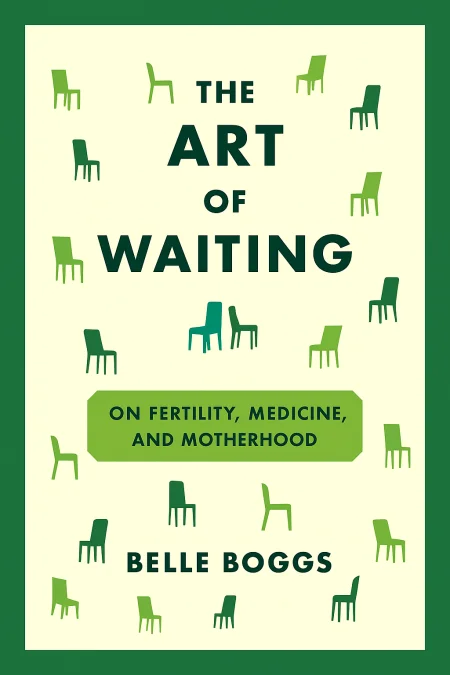
The Art of Waiting
On Fertility, Medicine, and Motherhood
Book Edition Details
Summary
In "The Art of Waiting," Belle Boggs offers a poignant tapestry of yearning and resilience, weaving through the intricacies of fertility with both a personal lens and a wider societal gaze. Her narrative dances through the rhythms of nature's cycles and the unpredictable twists of human longing, capturing everything from cicadas to gorillas as metaphors for the elusive desire to nurture life. With a blend of empathy and insight, Boggs delves into the cinematic and literary realms, dissecting portrayals of parenthood and absence while illuminating the intricate web of adoption, surrogacy, and the profound solitude of child-free choices. This heartfelt exploration transcends mere personal reflection, inviting readers to ponder the myriad paths to family, identity, and the quiet art of waiting.
Introduction
On a warm spring evening, Sarah stared at the pregnancy test in her hands, watching the single line appear where she desperately hoped to see two. It was the forty-seventh time she had taken this test, the forty-seventh time her body had failed to give her what felt like the most natural thing in the world. In that bathroom, surrounded by the accumulated weight of months of disappointment, she began to understand that her journey to motherhood would be nothing like she had imagined. This is the reality for millions of women and couples who find themselves in the unexpected territory of infertility, a place where the simple desire for a child becomes a complex navigation of medical procedures, emotional upheaval, and profound questions about identity and purpose. Through intimate storytelling and compassionate exploration, this narrative reveals the hidden world of those who wait, hope, and fight for the families they dream of creating. It illuminates not just the medical and emotional challenges of infertility, but the broader cultural forces that shape how we understand family, success, and what it means to be complete. For anyone who has ever waited for something that seemed just beyond reach, these stories offer both recognition and hope, reminding us that our worthiness is never measured by our ability to fulfill conventional expectations, and that love takes many forms on its journey to find us.
The Struggle to Conceive: Nature's Cruel Lottery
In the woods where the author lives, thirteen-year cicadas emerge from underground, their singular purpose echoing through the trees in a vibrating hum of reproduction. While nature around her explodes with fertility—turtle hatchlings, eaglets, feral cats giving birth under porches—she sits in a sterile waiting room, holding a medical journal with a startled baby monkey on its cover, contemplating her own inability to conceive. The monkey in the photograph, born to a mother exposed to radiation as part of fertility research, becomes a haunting symbol. Its wide eyes seem to ask the same question that torments her: what happens when the biological imperative that drives all living things simply fails to work? She learns that even animals closest to humans experience infertility, hormonal imbalances, and reproductive challenges. Yet somehow, animals seem to accept their circumstances with a grace that eludes human understanding. After four failed intrauterine inseminations, her doctor delivers news with clinical efficiency: "I think it's time to move on to something else." The contrast between the natural world's abundant fertility outside and the medical intervention required inside these walls becomes almost unbearable. She drives home through the cacophony of cicadas, each one successfully fulfilling its reproductive destiny, while she carries the weight of another failed attempt. This tension between natural expectation and biological reality reveals a profound truth: that fertility, despite being the foundation of all life, remains one of nature's most unpredictable gifts, distributed with no regard for worthiness, preparation, or desire.
Exploring Alternatives: Adoption and Other Paths
When Nate and Parul Goetz received an unexpected call from their adoption agency, they had exactly twenty-four hours to decide if they wanted to claim a premature baby boy born in a Kentucky hospital. His birth mother, Kate, had chosen them from hundreds of prospective parents not because of their carefully crafted family profile, but because of a strange symmetry she discovered in their home study: she had given birth to six children before this baby, and Parul had suffered six miscarriages. This seventh child would be Parul's seventh attempt at motherhood. They packed their unwashed baby shower gifts into suitcases and drove through the night, arriving to meet their son just hours after his birth. Kate's choice had been based on an intuitive sense of fate, a belief that this child belonged with this couple who had waited so long. Yet the story behind their matching revealed the complex intersection of loss, hope, and circumstance that defines modern adoption. For couples facing infertility, adoption often presents itself as a logical next step, a way to bypass the body's failures and embrace a different path to parenthood. Yet this seemingly straightforward solution carries its own labyrinth of emotional, financial, and ethical considerations. International programs that initially seem promising suddenly suspend operations due to corruption concerns. Domestic adoption involves navigating the complex emotions of birth mothers who may change their minds, and the reality that healthy infants are far less available than popular culture suggests. The landscape of adoption reveals itself to be not a simple alternative to biological parenthood, but another form of waiting, hoping, and confronting uncertainty. Each path forward requires its own form of courage, its own willingness to embrace the unknown in service of love.
Medical Intervention: The Promise and Cost of IVF
In Dr. Ramos's laboratory, embryos develop under constant observation, their cell divisions carefully monitored and documented with the precision of scientific protocol. She describes each stage with genuine wonder—the fusion of pronuclei, the formation of perfectly even cells, the emergence of blastocysts that look like tiny soccer balls under the microscope. "Look! How beautiful!" she exclaims, showing photographs of eight-celled embryos floating in petri dishes, each one a potential life created through the marriage of hope and technology. The author's own IVF cycle unfolds with choreographed precision: nightly injections administered by her husband, daily blood draws to monitor hormone levels, ultrasounds to count growing follicles. Her kitchen table becomes a medical station cluttered with vials, syringes, and detailed instructions. Each injection carries the weight of accumulated months of failure and the promise of possible success. The process requires a complete surrender of control, allowing medicine to take over every aspect of her body's natural rhythms. When retrieval day arrives, thirteen eggs are collected under sedation, eleven prove mature enough for fertilization, and ten successfully combine with sperm to become embryos. The numbers become markers of hope, each successful division a small victory. On transfer day, they choose the "prettiest" embryo, already hatching from its protective shell, and watch on ultrasound as it's placed in precisely the right location within her uterus. The irony of IVF lies in its promise of control over the fundamentally uncontrollable process of human reproduction. While technology can orchestrate the meeting of egg and sperm, monitor every stage of embryonic development, and optimize conditions for implantation, it cannot guarantee the mystery of why some embryos thrive while others fail, why some women's bodies welcome these scientifically perfect creations while others reject them entirely.
Finding Peace: Acceptance and New Beginnings
On the shortest day of the year in Iceland, standing on a glacier as darkness fell around them, the author carved her initials with her husband's in the snow—the most ephemeral of gestures. They had come seeking the northern lights, hoping for some cosmic sign about their reproductive future, but found only clouds and the profound silence of winter. Yet in that moment of accepting what they could not see or control, something shifted toward peace. The path to acceptance had been gradual, built through accumulating experiences that slowly changed her relationship with uncertainty. Meeting Willis, the eugenics victim who had lived his entire adult life knowing he could never father children yet found ways to contribute meaningfully to his community. Attending support group meetings where she witnessed other couples navigate their own difficult choices with grace and determination. Writing and teaching and maintaining friendships that weren't defined by reproductive status. Back home, their well-drilling project succeeded against the odds, five gallons per minute of clear water flowing from six hundred feet underground. It seemed like a metaphor for persistence rewarded, for the way sustained effort can occasionally break through resistant circumstances. Yet the author had already learned that contentment couldn't depend on such victories, that peace required finding meaning in the waiting itself rather than only in its resolution. When pregnancy finally came through their first IVF cycle, it felt both miraculous and inevitable, the culmination of a journey that had changed them far beyond their reproductive status. The daughter who arrived carried with her not just their genetic material, but the accumulated wisdom of everyone who had supported their path—doctors, nurses, friends, fellow travelers in the land of infertility. She belonged not just to her parents, but to the community that had helped bring her into existence.
Summary
These intertwined stories of longing, loss, and unexpected grace reveal that the journey to parenthood—or the acceptance of life without children—is never simply about reproduction, but about discovering who we become when our deepest assumptions about life's trajectory prove inadequate. Through medical waiting rooms and adoption interviews, through failed cycles and successful interventions, through the daily practice of hope sustained in the face of uncertainty, we learn that our capacity for love extends far beyond our biological functions. The true art of waiting lies not in passive endurance, but in remaining open to transformation, allowing our desires to mature into wisdom, and recognizing that every path toward family—whether through birth, adoption, or the creation of chosen communities—requires the same fundamental courage to love without guarantees. In a world that often measures worth by conventional achievements, these stories remind us that our deepest purpose may be found not in what we produce, but in how gracefully we learn to hold both hope and acceptance simultaneously, creating space for joy to arrive in forms we never anticipated.
Related Books
Download PDF & EPUB
To save this Black List summary for later, download the free PDF and EPUB. You can print it out, or read offline at your convenience.
By Belle Boggs
