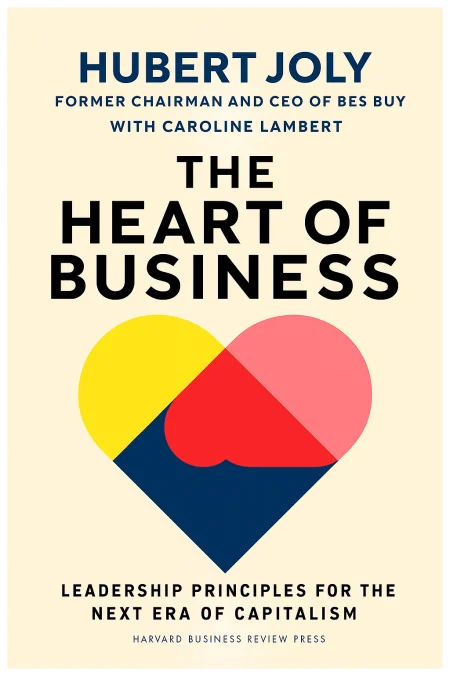
The Heart of Business
Leadership Principles for the Next Era of Capitalism
byHubert Joly, Caroline Lambert
Book Edition Details
Summary
A cold Minnesota autumn marked the start of Hubert Joly's audacious journey as the CEO of Best Buy, a role he embraced amid whispers of impending doom at the hands of Amazon's retail juggernaut. In a world teetering on the edge of obsolescence, Joly infused the beleaguered electronics giant with an ethos centered on humanity and purpose, transforming it into a beacon of corporate success and a coveted workplace. "The Heart of Business" unveils the magic behind this metamorphosis, advocating for a leadership style that prizes human connection over cold analytics. Joly's narrative is a clarion call for a new era of capitalism—one that marries profit with purpose. As businesses navigate the uncharted waters of a post-pandemic world, his insights provide a guide to crafting organizations that not only survive but flourish by nurturing the human spirit.
Introduction
In boardrooms across the globe, a quiet revolution is taking place. Leaders are discovering that the old formulas of command-and-control management, profit-at-all-costs thinking, and superhero leadership styles are not only outdated but actively harmful to both people and performance. What if the secret to extraordinary business success lies not in squeezing more productivity from human resources, but in unleashing the full potential of human beings? What if work could be transformed from a necessary burden into a source of meaning, connection, and fulfillment? This transformation begins with a fundamental shift in how we view the relationship between purpose, people, and profit. When leaders dare to put humanity at the center of their organizations, they discover something remarkable: businesses don't just perform better financially, they become forces for genuine good in the world. The path forward requires courage to challenge conventional wisdom and embrace a more human way of leading.
Redefining Work as Purpose, Not Punishment
Work has long been viewed through the lens of Adam's curse, a necessary evil that we endure to earn our survival. This perspective has created a global epidemic of disengagement, where fewer than 20 percent of employees feel truly invested in their jobs. Yet this widespread disconnection isn't inevitable, it's a choice we've made about how to frame the human experience of work. Consider the story of two masons working on a medieval cathedral. When asked about their labor, the first replied, "I'm cutting stones," while the second declared, "I'm building a cathedral." Both performed identical tasks, but their dramatically different perspectives shaped their entire experience. The second mason understood something profound: work is not merely about the physical tasks we perform, but about the larger purpose we serve and the meaning we create. This shift from viewing work as punishment to seeing it as purpose transforms everything. When a Best Buy sales associate helps a three-year-old boy whose beloved toy T-rex has broken, she isn't just processing a return. She becomes a doctor performing surgery, narrating the dinosaur's rescue and healing to a delighted child. The work becomes an expression of care, creativity, and human connection. The practical steps to redefine work begin with personal reflection. Ask yourself what drives you beyond the paycheck. Connect your daily tasks to the broader impact they create. Help others in your organization see how their contributions matter to something larger than themselves. When work becomes aligned with purpose, it transforms from energy-draining obligation into energy-giving opportunity. Remember that this transformation starts with you. The longest journey you'll ever take is the 18 inches from your head to your heart. When you connect with what truly motivates you and help others do the same, you begin to unlock the extraordinary potential that lies dormant in every workplace.
Building Organizations That Put People First
The traditional business model treats people as human capital, resources to be optimized for maximum output. This mechanistic view fundamentally misunderstands what drives exceptional performance in today's economy. Organizations that truly thrive recognize a simple but revolutionary truth: companies are not soulless entities designed to maximize shareholder value, but human communities united by shared purpose. When Hurricane Maria devastated Puerto Rico, Best Buy's response revealed the power of people-first thinking. District manager Davian Altamiranda couldn't locate any of the company's 300 employees on the island after the storm. Rather than waiting for official disaster relief, he asked his supervisor for a cargo plane. "Okay, let's see what we can do," came the immediate reply. Soon, Amber Cales and her team were organizing the first of fourteen relief flights, delivering supplies and evacuating employees and their families to safety. This wasn't a calculated public relations move, it was an authentic expression of organizational values. The company continued paying employees for four weeks while stores remained closed, and those who volunteered in community rebuilding efforts stayed on payroll. When the San Juan store reopened three months later, more than a hundred customers lined up before opening, greeting staff with wild applause. Remarkably, all three island locations saw sales jump 10 to 15 percent year-over-year. Building people-first organizations requires intentional design around three core elements. First, establish a noble purpose that connects individual aspirations with collective impact. Second, create systems and processes that demonstrate genuine care for employee wellbeing and growth. Third, measure success not just in financial terms, but through metrics that capture human flourishing and community contribution. The most important shift is viewing people as unique individuals rather than interchangeable parts. When leaders take time to understand what drives each person, they can create environments where everyone contributes their best self to shared goals. This approach doesn't just feel good, it delivers extraordinary business results that seem almost irrational to traditional thinking.
Unleashing Human Magic Through Connection and Growth
Human magic happens when ordinary people achieve extraordinary results because they feel deeply connected to their work, their colleagues, and their purpose. This isn't wishful thinking or soft management theory, it's a practical approach that consistently delivers what can only be described as irrational performance. The secret lies in creating environments where five key ingredients combine to ignite human potential. Jason Luciano, manager of a Best Buy store in Boston, discovered this magic by asking every team member a simple question: "What is your dream?" One young woman shared her dream of moving into her own apartment, but her hourly wage made this seem impossible. Together, they mapped out a development plan that would help her grow into supervisory roles. With support and coaching, she gained confidence, improved her department's performance, and eventually achieved her dream of independence. The transformation wasn't just personal, it was organizational. Jason's store consistently outperformed others because his team felt seen, valued, and supported in pursuing their aspirations. The connection between individual dreams and company purpose created an energy that customers could feel and colleagues wanted to emulate. The five ingredients of human magic work in harmony. First, connect individual purpose with organizational mission. Second, build authentic human relationships based on trust and vulnerability. Third, foster autonomy by pushing decision-making to those closest to the work. Fourth, create opportunities for mastery through coaching and development. Fifth, maintain a growth mindset that sees possibilities rather than limitations. Implementing these ingredients requires daily attention and genuine commitment. Start by having meaningful conversations with your team about their aspirations. Create psychological safety where people can be vulnerable and ask for help. Delegate real authority along with responsibility. Invest in individual development rather than generic training programs. Celebrate learning and growth, even when it comes through failure. When these elements align, something magical happens. People stop watching the clock and start watching for opportunities to contribute. They bring creativity, energy, and passion to challenges that once seemed insurmountable. This is how extraordinary results emerge from ordinary circumstances.
Leading with Authenticity in the New Era
The old model of leadership as heroic individualism is not just outdated, it's counterproductive in today's interconnected world. The superhero CEO who has all the answers and makes all the decisions creates bottlenecks, stifles innovation, and ultimately becomes the limiting factor in organizational growth. Authentic leadership in the new era requires a fundamentally different approach built on five essential principles. Corie Barry, who succeeded as CEO at Best Buy, exemplifies this new model. Her purpose is simple yet profound: "to leave something a little better than when I found it, whether in my community, in my family, or at Best Buy." This clarity guides her decisions and helps her connect with others around shared values. Each evening, she asks herself how things were better that day because of her presence and contribution. The story of Kamy Scarlett, Best Buy's head of human resources, demonstrates the power of vulnerable leadership. When she shared her decade-long struggle with depression on the company blog, it unleashed an outpouring of support and connection. Hundreds of employees responded with their own stories, and many sought help for the first time. One young woman even credited Kamy's openness with helping her choose life over suicide. The five principles of authentic leadership form a coherent framework. Be clear about your purpose and help others connect theirs with the organization's mission. Be clear about your role as someone who creates energy and possibility rather than having all the answers. Be clear about whom you serve, recognizing that true power comes from empowering others. Be driven by values that guide decisions even when they're difficult or costly. Be authentic by bringing your whole self to work and encouraging others to do the same. Practicing these principles requires daily discipline and self-reflection. Start each day by connecting with your deeper purpose. Ask yourself how you can serve others rather than advance yourself. Make decisions through the filter of your values, especially when under pressure. Share your struggles and uncertainties as well as your strengths. Create environments where others feel safe to do the same. The transformation from heroic to authentic leadership isn't always easy, but it's essential for creating organizations that can thrive in our complex, rapidly changing world. When leaders model vulnerability, service, and growth, they give permission for everyone else to bring their best selves to work.
Summary
The heart of business beats not with the rhythm of quarterly profits or market dominance, but with the pulse of human connection and shared purpose. As one leader discovered, "Work is love made visible," and when we embrace this truth, we transform not just our organizations but our entire relationship with what it means to create value in the world. The companies that will thrive in the coming decades are those that recognize a fundamental truth: people are not resources to be optimized, but individuals capable of extraordinary contribution when they feel valued, connected, and aligned with something larger than themselves. Your journey toward purposeful leadership begins with a single step: look around your organization today and ask how you can help one person connect their deepest aspirations with the work they do. When you make that connection, you plant the seeds of transformation that will grow into the kind of business the world desperately needs.
Related Books
Download PDF & EPUB
To save this Black List summary for later, download the free PDF and EPUB. You can print it out, or read offline at your convenience.
By Hubert Joly
