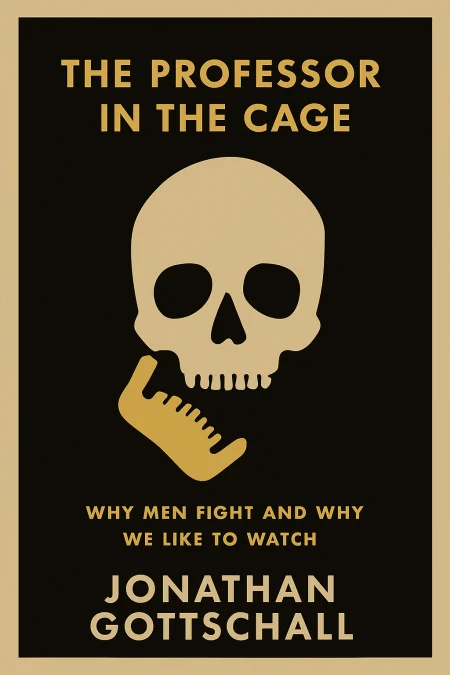
The Professor in the Cage
Why Men Fight and Why We Like to Watch
Book Edition Details
Summary
In a daring quest to unmask the primal allure of violence, Professor Jonathan Gottschall trades chalk for gloves and steps into the heart-pounding arena of mixed martial arts. The Professor in the Cage (2015) transcends mere academic exploration, delving deep into the visceral world where intellect meets instinct. Through a riveting blend of cutting-edge science and a rich tapestry of historical insight, Gottschall illuminates the ancient impulses that draw us to the spectacle of combat. This captivating narrative challenges readers to confront the paradox of our civilized selves enthralled by the chaotic dance of fists and fury. For those intrigued by the shadowy corners of human nature, this book promises a thought-provoking journey into the depths of our most unspoken desires.
Introduction
Violence permeates human existence in ways both obvious and subtle, from the gladiatorial spectacles of ancient Rome to the modern boxing rings and mixed martial arts cages that draw millions of viewers. Yet our relationship with violence remains deeply contradictory—we simultaneously condemn it as barbaric while being irresistibly drawn to watch it unfold. This paradox extends beyond mere spectatorship to the fundamental question of why men, across cultures and throughout history, have engaged in ritualized combat despite its apparent costs and dangers. The exploration of male violence requires moving beyond simplistic explanations that dismiss fighting as mere brutality or primitive behavior. Instead, it demands a rigorous examination of the evolutionary, psychological, and social forces that have shaped human conflict patterns over millennia. Through combining personal experience in mixed martial arts training with extensive research into anthropology, evolutionary biology, and historical records, a comprehensive framework emerges for understanding how ritualized violence functions as a complex social institution. The analysis reveals that what appears to be senseless aggression actually serves crucial functions in establishing social hierarchies, managing conflicts, and maintaining group cohesion. By examining everything from childhood play patterns to professional sports to formal dueling traditions, we can trace the sophisticated ways human societies have channeled violent impulses into structured, rule-bound contests that minimize actual harm while maximizing social benefits.
The Evolutionary Logic of Male Combat and Ritual Fighting
The ubiquity of male combat across human cultures points to deep evolutionary roots that extend far beyond cultural conditioning or social learning. Male mammals consistently display higher levels of physical aggression and risk-taking behavior, patterns that emerge from fundamental differences in reproductive biology. While females invest heavily in each offspring through pregnancy and nursing, males can potentially reproduce with multiple partners, creating intense competition for access to mates. This reproductive asymmetry has profound implications for male behavior and physiology. Men possess significantly greater upper body strength, faster reflexes, and higher pain tolerance than women—traits that would be metabolically expensive to maintain without corresponding evolutionary advantages. The genetic evidence supports this interpretation: studies of human DNA reveal that throughout history, roughly twice as many women as men successfully reproduced, indicating that male reproductive success was highly variable and dependent on competitive ability. The concept of ritual combat emerges as nature's solution to a fundamental problem: how to resolve conflicts and establish dominance hierarchies without the catastrophic costs of unrestricted warfare. From elephant seals clashing on beaches to deer locking antlers in forest clearings, animals across species engage in formalized contests governed by implicit rules that limit escalation. These biological precedents provide the template for human dueling traditions, which represent sophisticated cultural elaborations of ancient competitive patterns. Human ritual combat serves multiple functions simultaneously: it allows individuals to demonstrate their fighting ability to potential rivals and mates, establishes clear social hierarchies that reduce ongoing conflict, and provides a mechanism for resolving disputes without destroying social bonds. The key insight is that these contests are fundamentally about information exchange—they allow participants and observers to assess relative strength, skill, and determination in ways that minimize actual violence while maximizing social utility.
From Ancient Duels to Modern Sports: Civilizing Violence
The historical trajectory of human combat reveals a consistent pattern of increasing ritualization and rule-bound structure. Ancient dueling codes, from medieval tournaments to the elaborate pistol duels of the early American republic, demonstrate how societies have repeatedly developed formal mechanisms for channeling violent impulses into socially acceptable forms. These systems emerged not to eliminate conflict but to contain and regulate it according to shared principles of honor and fairness. The European dueling tradition illustrates this civilizing process in remarkable detail. What began as crude blood feuds gradually evolved into highly sophisticated contests governed by elaborate codes of conduct. Duelists were required to follow specific procedures for issuing challenges, selecting weapons, and conducting the actual combat. Most importantly, these codes included built-in mechanisms for de-escalation, such as the requirement for seconds to attempt reconciliation and the acceptance of minor wounds as sufficient to satisfy honor. Modern sports represent the culmination of this civilizing process, transforming the raw materials of combat into elaborate games that retain the competitive intensity of fighting while dramatically reducing the risk of serious injury. Football, boxing, wrestling, and martial arts all preserve the essential elements of ritualized combat—the testing of strength, skill, and courage before an audience—while embedding them within comprehensive rule systems that protect participants. The transition from deadly duels to modern sports reflects broader social changes, particularly the strengthening of state institutions capable of providing justice and maintaining order. As formal legal systems became more reliable, the practical necessity for personal violence declined, allowing combat traditions to evolve into purely recreational forms. However, the underlying psychological and social functions remain largely unchanged: sports continue to serve as arenas for establishing dominance, demonstrating masculine virtues, and managing inter-group competition in relatively safe ways.
The Paradox of Spectatorship: Why We Crave Violence We Condemn
The phenomenon of violence spectatorship presents one of the most puzzling aspects of human behavior: millions of people who would never engage in physical combat themselves derive intense pleasure from watching others fight. This contradiction extends across the spectrum of violent entertainment, from professional sports to action movies to the gladiatorial contests that have captivated audiences throughout history. Understanding this paradox requires examining both the evolutionary origins of our attraction to violence and the psychological mechanisms that allow us to enjoy simulated aggression. From an evolutionary perspective, the ability to assess fighting ability in others would have provided crucial survival advantages for our ancestors. Observing combat allows individuals to gather valuable information about potential allies and enemies without the risks associated with direct confrontation. Spectators can evaluate strength, skill, courage, and tactical ability in ways that inform their own social strategies and alliance decisions. This information-gathering function helps explain why combat sports consistently draw larger and more passionate audiences than non-competitive athletic events. The psychological appeal of violent spectacles operates through multiple channels simultaneously. Watching skilled fighters engage in combat triggers physiological arousal similar to that experienced during actual conflict, providing a safe way to experience the excitement of violence without its dangers. The tribal nature of most combat sports—with clear heroes and villains representing different groups or communities—allows spectators to experience vicarious victory and defeat, satisfying deep-seated needs for group identity and status competition. However, this attraction to violence creates significant moral tension in modern societies that officially condemn aggression while simultaneously celebrating it in entertainment contexts. The resolution of this paradox often involves elaborate justifications that frame violent entertainment as serving higher purposes: sports build character, action movies explore themes of justice, and combat sports demonstrate human courage and determination. These rationalizations allow individuals to enjoy violent spectacles while maintaining their self-image as peaceful, civilized people who deplore actual violence.
Beyond Barbarism: How Fighting Serves Social Order
Rather than representing a breakdown of civilized behavior, ritualized fighting actually serves as a crucial mechanism for maintaining social stability and order. This counterintuitive insight emerges from careful examination of how combat traditions function within their broader social contexts. Far from promoting chaos and destruction, structured violence provides societies with sophisticated tools for managing conflict, establishing hierarchies, and reinforcing cultural values. The social functions of ritualized combat operate at multiple levels simultaneously. At the individual level, fighting traditions provide young men with opportunities to demonstrate their courage, strength, and skill—qualities that have historically determined access to resources, mates, and social status. The public nature of these demonstrations ensures that information about individual capabilities circulates throughout the community, reducing uncertainty and potential conflicts over relative standing. At the group level, combat sports and martial traditions serve as mechanisms for building solidarity and managing inter-group competition. Team sports, in particular, allow communities to engage in symbolic warfare that satisfies competitive impulses while avoiding the devastating costs of actual conflict. The ritualized nature of these contests—with their elaborate rules, ceremonies, and traditions—transforms potentially destructive aggression into community-building activities that strengthen social bonds. The regulatory function of ritualized violence extends to its role in conflict resolution and social control. Traditional dueling systems provided mechanisms for resolving disputes that might otherwise escalate into blood feuds or community-wide conflicts. By channeling grievances into formal contests governed by shared rules and overseen by neutral parties, these systems helped maintain social order while allowing individuals to address perceived wrongs without undermining broader community stability. Modern legal systems have largely replaced these functions, but sports and martial arts continue to provide outlets for competitive impulses that might otherwise manifest in more destructive ways.
Summary
The fundamental insight emerging from this comprehensive analysis is that human violence, rather than representing a failure of civilization, actually constitutes one of its foundational elements. The sophisticated systems of ritualized combat that have emerged across cultures and throughout history demonstrate humanity's remarkable ability to transform potentially destructive impulses into socially beneficial institutions. These systems serve multiple crucial functions: they provide mechanisms for establishing and maintaining social hierarchies, offer safe outlets for competitive drives, create opportunities for demonstrating valued personal qualities, and supply communities with tools for managing both internal conflicts and external threats. The apparent paradox of civilized people being drawn to violent spectacles resolves when we recognize that this attraction serves important evolutionary and social functions, allowing individuals to gather crucial information about others while experiencing the excitement of competition in safe, controlled environments. This understanding suggests that rather than trying to eliminate our fascination with ritualized violence, we might be better served by ensuring that these ancient impulses are channeled through institutions that maximize their social benefits while minimizing their potential for harm.
Related Books
Download PDF & EPUB
To save this Black List summary for later, download the free PDF and EPUB. You can print it out, or read offline at your convenience.
By Jonathan Gottschall
