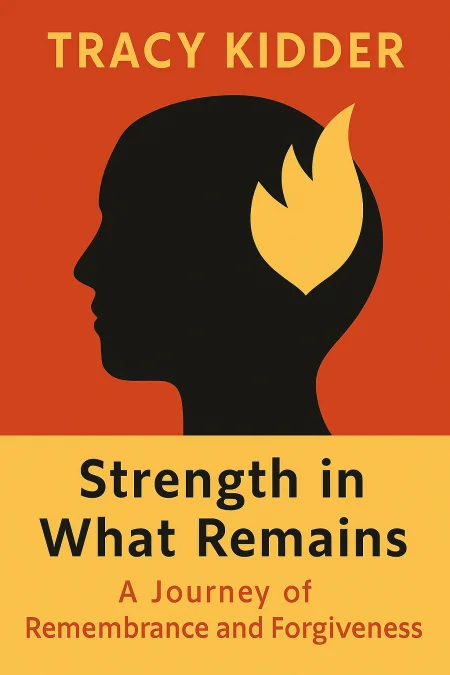
Strength in What Remains
A Journey of Remembrance and Forgiveness
Book Edition Details
Summary
In the shadow of a harrowing past, Deo steps onto American soil with little more than his indomitable spirit. "Strength in What Remains" by Pulitzer Prize-winning Tracy Kidder chronicles an epic tale of survival and resilience, where the echoes of war-torn Burundi clash with the chaos of New York City. With nothing but $200 in his pocket, Deo confronts a world that speaks a foreign tongue and presents unforgiving challenges. Yet, amidst this struggle, kindness emerges in unexpected places. Guided by strangers who believe in second chances, Deo's journey unfolds—a narrative of hope, unyielding will, and the transformative power of human connection. This is a story that celebrates the extraordinary within the ordinary, a testament to the incredible impact of empathy and tenacity.
Introduction
In the spring of 1994, a young medical student in Burundi found himself hiding under a hospital bed as machete-wielding militiamen prowled the corridors outside, their chants echoing through the concrete halls. Deogratias Niyizonkiza, known simply as Deo, was twenty-four years old when ethnic violence erupted across his homeland, forcing him to abandon his promising medical career and flee for his life. What followed was an extraordinary six-month odyssey through some of the darkest chapters of human history, as genocide consumed neighboring Rwanda and civil war tore apart his native Burundi. This is the story of a young man who walked barefoot through forests littered with corpses, survived refugee camps where danger lurked behind every smile, and ultimately found himself sleeping homeless in New York's Central Park with nothing but a plastic bag of belongings. Yet it is also a testament to the power of human resilience and the strangers who become saviors in our darkest hours. From his grandfather's gentle wisdom in the mountains of Burundi to the unexpected kindness of a nun on Manhattan's Upper East Side, Deo's journey reveals how hope can flourish even in the most desperate circumstances. Through his transformation from a terrified refugee to a healer building clinics for the poor, we witness not just one man's triumph over unthinkable trauma, but a profound meditation on what it means to find strength in what remains when everything else has been stripped away.
Escape from Hell: Flight Through Genocide
The morning of October 22, 1993, began like any other for Deo at the hospital in Mutaho, a remote town in northern Burundi. As a third-year medical student, he had requested this rural placement to escape the political tensions simmering in the capital. But when President Ndadaye, the country's first democratically elected Hutu leader, was assassinated by Tutsi military officers, ethnic violence exploded across the nation overnight. Deo, himself a Tutsi, awoke to find the hospital staff vanished and patients whispering in fearful clusters. The warning came from an unexpected source. A Hutu patient's brother, someone Deo had been treating for malaria, pulled him aside with urgent news: militiamen were systematically killing Tutsis throughout the region, and they were coming for the hospital. As the young man helped his sick brother flee, he turned back to Deo with words that would haunt him forever: "I know you're not going to survive. May God bless you." Within hours, the sounds of drums, whistles, and chanting filled the air as armed groups surrounded the medical complex. Deo spent the day crouched under his narrow hospital bed, listening to the methodical slaughter unfolding around him. Through the thin walls, he heard doors being smashed, patients screaming, and the terrible silence that followed. By some miracle, the militiamen who entered his room declared it empty and moved on, perhaps confused by the door he had forgotten to lock in his panic. As darkness fell and the sounds of killing gradually faded, he crawled from his hiding place to find the hospital courtyard strewn with bodies. His colleagues, his patients, people who had trusted him to heal them, all lay dead under the African stars. That night marked the beginning of a six-month journey that would take Deo across two countries as genocide consumed the region. Moving mostly at night through forests and banana groves, drinking from contaminated streams, and eating raw vegetables pulled from abandoned gardens, he learned to navigate by the sounds of violence, turning away from the drums and whistles that signaled fresh killing. The mountains of his childhood, once places of beauty and peace, became a landscape of terror where every encounter with another human being could mean death.
Lost in America: From Homelessness to Hope
When Deo's plane touched down at JFK Airport in May 1994, he possessed two hundred dollars, no English, and memories so fresh they sometimes confused present with past. The businessman's visa in his pocket identified him as a coffee trader, though he had never sold a bean in his life. What struck him first about America wasn't its wealth or opportunity, but the simple fact that no one looked afraid. After six months of reading terror in every face he encountered, the sight of people going about their daily business without glancing over their shoulders seemed like a miracle. The miracle proved short-lived. Muhammad, a Senegalese baggage handler who befriended Deo at the airport, took him to an abandoned tenement in Harlem where homeless people squatted in rooms reeking of urine and decay. The building's walls were covered with graffiti spelling "PEN" in letters that looked swollen with menace. Here, surrounded by addicts and the desperate, Deo discovered that survival in America required different skills than those that had saved him in the forests of Central Africa. A single subway token cost more than many Burundians earned in a day, yet without understanding the transit system, he was trapped. His first job delivering groceries on Manhattan's Upper East Side became a daily exercise in humiliation. Goss, the store manager, would poke him with a long wooden stick to get his attention, as if he were livestock rather than a human being. The wealthy customers he served through service entrances never looked him in the eye, and when they tipped at all, it was with the casual indifference of feeding pigeons. Deo had grown up poor, but in Burundi poverty came with dignity. Here, he felt invisible, reduced to what he called "someone with a primate brain." The breaking point came when he found himself sleeping rough in Central Park, among the homeless men who gathered near the statue of a long-dead sculptor. The irony wasn't lost on him: he had fled a country where dogs trotted through villages carrying human heads, only to end up hiding from police among the bushes of America's most famous park. Yet even in this lowest moment, when suicide seemed like a reasonable option, something in Deo refused to surrender. Perhaps it was his grandfather's voice reminding him that a person could find strength anywhere, or simply the stubborn resilience that had carried him across two countries. Whatever it was, it kept him alive long enough for help to arrive in the most unlikely form: a former nun named Sharon who saw past his ragged appearance to the extraordinary person beneath.
Finding Purpose: Education and Transformation
The woman who opened the door at St. Thomas More rectory that spring day in 1994 changed everything. Sharon McKenna, a former Benedictine nun turned informal social worker, took one look at Deo's emaciated frame and buck teeth and saw not another charity case, but a human being in need of restoration. When he told her he was "very interested" upon learning he had delivered groceries to a church, something in his response convinced her that this skeletal young man deserved more than the usual handout. Sharon's relentless advocacy led Deo to Charlie and Nancy Wolf, the artist couple who would become his American parents. Their SoHo loft, with its wall of windows overlooking the city and shelves crammed with books, felt like a sanctuary after the chaos of the streets. In the windowless room they dubbed the Black Hole, surrounded by more books than existed in all of Burundi, Deo began the slow process of rebuilding not just his life, but his sense of who he might become. The couple's dinner table discussions about American idioms became impromptu English lessons, their arguments over word meanings teaching him that even native speakers were still learning their own language. The path to Columbia University seemed impossible until it wasn't. Deo's refugee status initially barred him from most colleges, but Columbia's School of General Studies had been designed for students whose careers had been interrupted. The photograph in his application file showed his face crossed out with a black marker, officially declaring him dead. Yet here he was, alive and determined to resurrect not just his own dreams but his understanding of the world that had tried to destroy him. The chemistry professor who regraded his exam from zero to A-minus after realizing Deo had simply written chemical formulas in the French order became an early ally in his academic resurrection. Philosophy classes in the shadow of Rodin's Thinker provided a framework for processing the incomprehensible. If human beings were rational creatures, as his moral philosophy instructor insisted, then what explained Rwanda? If God was just, then why had innocent babies been left to die in banana groves? These weren't merely academic questions for Deo, but existential puzzles that interrupted his sleep and haunted his waking hours. Yet gradually, through four years of rigorous study, he developed what he called "a flexible mind," one that could hold paradox and uncertainty while still believing in the possibility of human goodness. By graduation, he had learned to find God not in grand explanations, but in the quiet presence of the people who had saved him along the way.
Return to Heal: Building a Clinic in Burundi
Fourteen years after fleeing Burundi, Deo stood on the red earth of Kayanza village, surrounded by hundreds of people who had waited hours for his return. His parents, aged beyond their years by war and displacement, beamed with pride as their son outlined his vision for bringing modern medicine to this remote corner of the mountains. The crowd had already begun making bricks and collecting stones for the foundation, their enthusiasm tangible despite the enormity of the task ahead. Here, in a village where 99 percent of residents were Hutus and he was one of only two Tutsi families, Deo had chosen to make his stand against the poverty and disease that made genocides possible. The decision to build Village Health Works in Kayanza wasn't just about medicine; it was about proving that former enemies could work together toward life rather than death. Every day brought new challenges: trucks broke down carrying supplies up the mountain roads, corrupt officials demanded bribes, and the Belgian road construction company quoted fifty thousand dollars to improve access to the site. But when the village women heard that price, one mother with a sick baby strapped to her back declared they would rebuild the entire six-kilometer road themselves with machetes and hoes. Within days, 166 villagers had completed the work that foreign contractors deemed impossible. The clinic that opened in November 2007 represented more than just another rural health facility. It embodied Deo's philosophy that healing required addressing not just symptoms but root causes, not just individuals but entire communities. Solar panels powered computers that connected Kayanza to research hospitals around the world. Community health workers trained in modern techniques carried medicine to remote homesteads. Gardens surrounding the clinic buildings grew vegetables to fight malnutrition, while clean water flowed from a new filtration system to prevent waterborne diseases. Most importantly, the facility operated on the revolutionary principle that quality healthcare was a human right, not a privilege reserved for those who could pay. The transformation went beyond medicine. Former militiamen volunteered to help with construction projects. Elderly men who had spent decades fighting ethnic wars told Deo they wished they had devoted their lives to building rather than destroying. When patients arrived from across the border in Tanzania and even from the distant Congo, word spread that something unprecedented was happening in the mountains of Burundi. Here was proof that education and opportunity, not ethnic identity, determined what people might become when given the chance. In building a clinic for the poorest of the poor, Deo had constructed something far more ambitious: a working model of the world he believed was possible, where strength emerged from what remained after everything else had been stripped away.
Summary
Deogratias Niyizonkiza's journey from genocide survivor to healer illuminates a profound truth about human resilience: that our greatest strength often lies not in what we possess, but in what we refuse to surrender when everything else is taken away. His transformation from a terrified refugee sleeping in Central Park to a medical pioneer building hope in the mountains of Burundi demonstrates that the most powerful response to hatred is not vengeance, but the quiet determination to heal the world that wounded us. Through his story, we learn that education becomes revolutionary when it serves the marginalized, that strangers can become family when we choose compassion over fear, and that the line between victim and healer is often shorter than we imagine. Deo's life challenges us to ask what we might accomplish if we approached our own obstacles with his combination of intellectual rigor, moral courage, and unwavering faith in human possibility. For anyone seeking to understand how hope survives in the darkest circumstances, or how one person's vision can transform entire communities, his example offers both inspiration and practical guidance. In a world still scarred by ethnic violence and economic inequality, Deo's clinic stands as a monument to the revolutionary idea that healing is possible, and that sometimes the most profound changes begin with a single person willing to return to the source of their pain and plant seeds of possibility in that broken ground.
Related Books
Download PDF & EPUB
To save this Black List summary for later, download the free PDF and EPUB. You can print it out, or read offline at your convenience.
By Tracy Kidder
