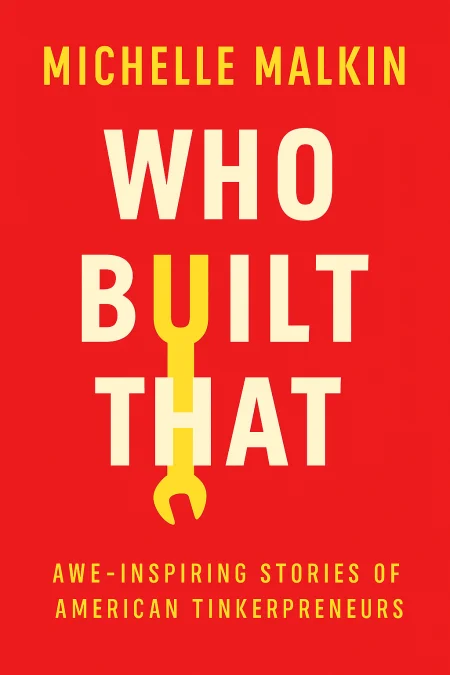
Who Built That
Awe-Inspiring Stories of American Tinkerpreneurs
Book Edition Details
Summary
In a world where the quiet brilliance of inventors often fades into obscurity, Michelle Malkin champions these unsung pioneers of progress in "Who Built That." This vibrant tapestry of American ingenuity reveals the tenacity and vision behind everyday innovations that have shaped our lives. Malkin's narrative, rich with the spirit of enterprise, takes readers from colonial glass workshops to the bustling heart of the Industrial Age and beyond, spotlighting the daring entrepreneurs who defied odds to bring their creations to life. From Abraham Lincoln's patent advocacy to Anthony Maglica's flashlight empire forged in a humble garage, Malkin crafts a stirring homage to the dreamers and doers who define American exceptionalism. Here, you'll find the real architects of innovation—ordinary people with extraordinary courage—whose stories illuminate the relentless pursuit of the American Dream.
Introduction
In the smoky workshops of 19th-century America, a revolution was brewing that would reshape the world. While European craftsmen remained bound by centuries-old guild traditions, American inventors were busy reimagining everything from bottle caps to bridges, transforming mundane problems into extraordinary opportunities. This transformation reveals profound truths about how individual creativity, when protected by law and rewarded by markets, can generate prosperity that benefits all of humanity. The stories within illuminate three crucial historical questions that textbooks often overlook. First, how did America's unique patent system democratize innovation in ways that European guild systems never could? Unlike the Venetian glass masters who were imprisoned to protect trade secrets, American inventors could secure legal protection for their ideas while freely sharing knowledge through networks of entrepreneurs and craftsmen. Second, why did immigrant entrepreneurs play such a vital role in building American industrial supremacy? From Croatian flashlight makers to Prussian bridge builders, these newcomers brought fresh perspectives unencumbered by established ways of thinking. Third, what can we learn about the relationship between individual ambition and collective progress in an age when both concepts face increasing skepticism? These accounts speak to entrepreneurs seeking to understand the foundations of American innovation, students of history curious about the hidden forces that shaped modern life, and anyone who believes that individual initiative remains the most powerful engine of human progress. The legacy of these forgotten architects lives in every convenience we enjoy today, reminding us that the next breakthrough is always just one stubborn dreamer away.
Foundations of Innovation: Early Industrial Pioneers (1800s-1880s)
The early decades of American independence witnessed an extraordinary flowering of mechanical genius that laid the groundwork for industrial supremacy. From the 1800s through the 1880s, a generation of immigrant dreamers and native-born tinkerers established the template for American capitalism through sheer audacity and relentless experimentation. Unlike their European counterparts, who remained trapped within restrictive guild systems, these pioneers enjoyed unprecedented freedom to fail, learn, and try again. Consider John Roebling, the Prussian engineer who fled European autocracy to build America's most iconic bridges. When bureaucrats in his homeland rejected his revolutionary suspension cable designs, America welcomed his vision with open arms. Similarly, William Painter's obsession with bottle caps might seem trivial until you realize his Crown Cork & Seal company revolutionized food safety and spawned entire industries. These men shared a crucial insight that separated American innovation from European tradition: rather than jealously guarding trade secrets, they embraced patent protection and knowledge sharing. The period's deeper significance lies in how these inventors democratized innovation itself. Previous generations had relied on apprenticeships and guild knowledge passed down through families. American tinkerpreneurs proved that a coal miner's son like Michael Owens could revolutionize glass manufacturing, or that a pharmacist like Charles Hires could build an empire from root beer. They understood that individual success multiplied when ideas could flow freely through networks of entrepreneurs, investors, and skilled craftsmen. This openness created a virtuous cycle where one breakthrough sparked dozens of others. The Roebling family's wire rope enabled telegraph communications that connected inventors across vast distances. Painter's innovations inspired countless imitators and improvers. Each success demonstrated that in America, unlike anywhere else in the world, ordinary people with extraordinary ideas could transform both their own fortunes and the trajectory of human progress.
The Age of Invention: Mass Production Revolution (1880s-1920s)
The closing decades of the 19th century and opening of the 20th marked humanity's great leap from handcraft to mass production, with American inventors leading the charge into modernity. This era transformed not just how things were made, but how people lived, worked, and imagined the future. The partnership between George Westinghouse and Nikola Tesla exemplified this transformation, as their harnessing of Niagara Falls created the foundation for electrochemical industries, automotive manufacturing, and urban development across the American heartland. When Westinghouse and Tesla's alternating current system proved superior to Edison's direct current, they weren't just winning a technical debate but establishing the infrastructure that would power the 20th century. Meanwhile, King Gillette's disposable razor blade, inspired by Painter's throwaway bottle caps, introduced Americans to an entirely new economic concept: planned obsolescence as consumer convenience. The Scott brothers overcame Victorian prudishness to create modern hygiene standards with toilet paper, while Willis Carrier's air conditioning made possible the development of the American South and Southwest. What drove this explosion of innovation was a uniquely American combination of individual ambition and collaborative capitalism. These inventors didn't work in isolation but formed intricate networks of mutual support. Painter mentored Gillette, who worked with Carrier's engineers to solve manufacturing problems. Each breakthrough created opportunities for dozens of others, demonstrating how creative destruction became creative construction. The period's lasting lesson lies in how these innovations multiplied prosperity rather than simply concentrating it. When Owens and Libbey's automated glass-making machines eliminated child labor in factories, they didn't just destroy jobs but created entire new industries while making glass products affordable for ordinary families. This wasn't mere technological progress but the birth of modern consumer capitalism, where individual inventors could build fortunes by solving problems for millions of people simultaneously.
Modern Makers: Technology and Human Enhancement (1920s-Present)
The transition from the Age of Invention to our modern era reveals how American tinkerpreneurship evolved from solving basic needs to enhancing human potential itself. From the 1920s forward, innovation increasingly focused on overcoming physical limitations and expanding the boundaries of human capability. The prosthetics industry exemplifies this evolution, as James Hanger's Civil War-era wooden leg gave way to sophisticated carbon-fiber limbs that restore not just mobility but dignity to amputees. Companies like Hanger Orthopedic Group and United Prosthetics represent the maturation of American innovation, evolving from individual inventors working in isolation to integrated networks of researchers, manufacturers, and healthcare providers. Today's advanced prosthetics, including neural-controlled limbs developed by researchers like Dean Kamen, demonstrate how modern tinkerpreneurs build upon centuries of accumulated knowledge while pushing into uncharted territory. These devices don't just replace lost function but often exceed natural human capabilities. This period also witnessed the institutionalization of innovation through corporate research labs, venture capital networks, and university partnerships. Yet the fundamental spirit remained unchanged. Whether it's Tony Maglica perfecting his flashlight design over decades or small companies like Bally Ribbon Mills adapting from military decorations to medical textiles, the core principles persist: identify unmet needs, experiment relentlessly, protect intellectual property, and never stop improving. The deeper transformation lies in how innovation became democratized through global supply chains and digital communication. Modern tinkerpreneurs can access materials, knowledge, and markets that previous generations couldn't imagine. A small Ohio company can develop prosthetic components used worldwide, while a Pennsylvania textile firm can pivot from ribbon-making to aerospace applications. Yet challenges persist that echo earlier eras, as regulatory barriers, intellectual property theft, and resistance to change continue to test innovators' resolve.
Summary
The grand narrative threading through American industrial history reveals a perpetual tension between individual creativity and collective resistance to change. From Venetian glass masters imprisoned to protect trade secrets to modern entrepreneurs battling regulatory capture, the forces of innovation have always faced determined opposition from those who profit from the status quo. What made America exceptional wasn't the absence of such resistance, but the creation of institutional frameworks that consistently favored innovators over incumbents. The tinkerpreneurs profiled here succeeded because America's unique combination of patent protection, venture capital, and competitive markets allowed them to fail without facing execution, protect their ideas through law rather than secrecy, and scale their successes through voluntary partnerships rather than royal monopolies. They could transform individual ambition into shared prosperity because the system rewarded those who solved problems for others rather than those who hoarded advantages for themselves. Today's innovators face familiar challenges in new forms, as regulatory complexity has replaced guild restrictions and global competition has intensified the pace of creative destruction. Yet the fundamental recipe for progress remains unchanged: identify problems others ignore, experiment until you find solutions, protect your intellectual property, and build networks of mutual support with fellow creators. The deepest lesson from these stories is that progress isn't inevitable but the product of individuals willing to risk everything on untested ideas. In an age of increasing pessimism about innovative capacity, these forgotten pioneers remind us that the next breakthrough is always just one stubborn dreamer away from transforming how we live, work, and thrive.
Related Books
Download PDF & EPUB
To save this Black List summary for later, download the free PDF and EPUB. You can print it out, or read offline at your convenience.
By Michelle Malkin
