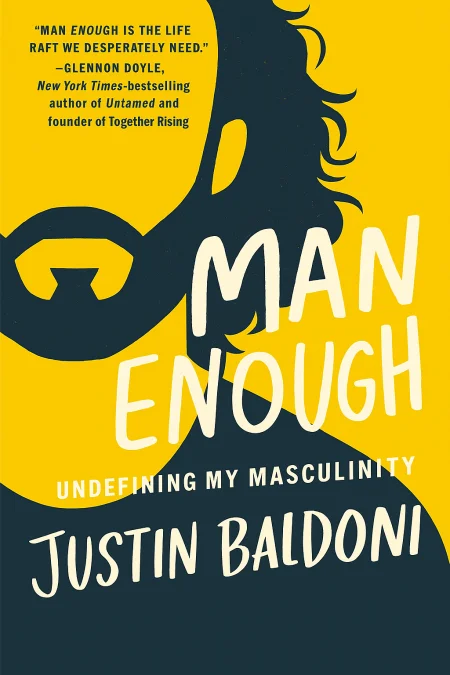
Man Enough
Undefining My Masculinity
Book Edition Details
Summary
In a world where the image of manhood is often a rigid suit of armor, Justin Baldoni dares to peel back the layers. His book, "Man Enough: Undefining My Masculinity," is an audacious invitation to reconsider what it means to be a man in today's society. With the heart of an artist and the candor of a close friend, Baldoni reflects on his own experiences, tackling the tough topics of strength versus vulnerability, and the societal scripts that dictate how men should act and feel. He champions a new narrative—one where men are encouraged to embrace sensitivity, to find courage in vulnerability, and to redefine masculinity on their own terms. This is not just a book; it's a movement towards a more authentic, empathetic way of being, challenging readers to dismantle old expectations and forge a path where humanity triumphs over stereotypes.
Introduction
Picture a thirteen-year-old boy standing on a bridge, twenty feet above a rushing river, his legs trembling as friends below shout "Jump! Don't be a pussy!" The water looks cold and unforgiving, and he's terrified of heights. But more than his fear of falling, he's terrified of being seen as weak, of being cast out from the group that defines his worth. So he jumps—not because he's brave, but because he's more afraid of losing his place among the boys than of breaking his bones. This moment captures the essence of a struggle that millions of men face daily: the exhausting performance of masculinity that demands we sacrifice our authentic selves for acceptance. From childhood through adulthood, we learn to wear armor that protects us from judgment while simultaneously cutting us off from genuine connection, vulnerability, and joy. We chase external validation through physical strength, financial success, and emotional stoicism, all while our hearts cry out for permission to simply be human. This exploration isn't about attacking masculinity or apologizing for being a man. It's about recognizing that the very traits we've been taught make us "man enough" often leave us feeling empty and disconnected. Through honest examination of our deepest insecurities and most guarded secrets, we can begin to understand that our perceived weaknesses might actually be our greatest strengths, and that true masculine power lies not in dominance over others, but in the courage to be vulnerable, authentic, and fully human.
The Bridge Jump: Learning to Perform Masculinity
The locker room fell silent as twelve-year-old Matt examined his emerging abs in the mirror, teasing his friend about pubic hair. When he turned to me, shirtless and vulnerable, asking where my abs were, something shifted inside my chest—a knot of inadequacy that would follow me for decades. What seemed like innocent boyhood teasing was actually my first lesson in the unwritten rules of masculinity: your worth as a man is measured by how your body compares to other men's bodies. That moment wasn't isolated. It was part of a systematic education that began in elementary school playgrounds and continued through high school hallways, teaching me that sensitivity was weakness, that asking for help was failure, and that emotions were the enemy of manhood. I learned to perform confidence when I felt insecure, to act tough when I felt tender, and to pretend I had all the answers when I was drowning in questions. The performance became so convincing that even I believed it. I developed what looked like overconfidence to mask my deep-seated insecurities. I interrupted conversations to assert dominance, took up physical space without regard for others, and learned to explain topics I barely understood. Every interaction became a test of my masculinity, judged not by my own standards but by an invisible panel of other men who seemed to have figured out the secret code I was still trying to crack. Years later, I realized that the armor I'd constructed to protect myself from rejection was actually preventing me from experiencing genuine connection. The very performance that earned me acceptance in the boys' club was costing me authentic relationships with the people I loved most. The tragedy wasn't that I was performing masculinity—it was that I'd forgotten there was a real person underneath the performance, desperately wanting to be seen and accepted for who he truly was.
Behind the Armor: When Traditional Scripts Fail Us
At twenty-nine, I was planning one of the most elaborate marriage proposals of all time for the woman I knew was my soulmate. Yet even as I orchestrated this grand gesture of love, I found myself gripped by cold feet—not because I didn't love Emily, but because society had convinced me that marriage would somehow diminish my manhood. The messages were everywhere: married men lose their freedom, their identity, their power. I was about to commit to the person who made me feel most like myself, yet I was terrified of what that commitment would say about me as a man. This internal conflict revealed a deeper truth about masculine conditioning: we're taught to view intimacy as a threat to our independence rather than a source of strength. The same culture that celebrates the lone wolf mythology makes it nearly impossible for men to admit we need connection, support, and emotional intimacy. We learn to compartmentalize our relationships, keeping our deepest fears and insecurities locked away even from those closest to us. The cost of this emotional isolation became clear during a trip to Mexico with my closest male friends. For three days, I carried the weight of a personal struggle, desperately wanting to share but paralyzed by the fear of appearing weak. When I finally found the courage to be vulnerable about my relationship with pornography, something magical happened. My honesty gave permission for others to share their own hidden battles—infidelity, childhood trauma, addiction, depression. We discovered that beneath our carefully constructed facades, we were all fighting similar demons and craving the same thing: to be known and accepted in our full humanity. That night taught me that vulnerability isn't the opposite of strength—it's the foundation of it. The armor we wear to protect ourselves from judgment actually prevents us from receiving the love and support we desperately need. True intimacy requires the courage to remove that armor, to risk being seen as imperfect, and to trust that our authentic selves are worthy of love and belonging.
Breaking the Silence: Vulnerability as Revolutionary Strength
The statistics are staggering: men are nearly four times more likely to die by suicide than women, with middle-aged white men representing the highest risk group. Behind these numbers are countless stories of men who suffered in silence, convinced that reaching out for help would somehow compromise their masculinity. My cousin Scott was one of them—a loving, intelligent young man whose death left our family grappling with the devastating question: "What if we had known how much he was struggling?" The tragedy is that most men experiencing depression, anxiety, or suicidal thoughts don't recognize these as treatable conditions—they see them as personal failures, evidence that they're not man enough to handle life's challenges. We've created a culture where admitting you're struggling is seen as weakness rather than wisdom, where asking for help is viewed as defeat rather than courage. But change is possible, and it starts with redefining what it means to be brave. True bravery isn't jumping off a bridge to prove your fearlessness—it's having the courage to admit when you're afraid. It's the veteran walking into a therapist's office to address his trauma, the father acknowledging his struggles with depression, the teenager telling a friend he's having thoughts of suicide. These acts of vulnerability require more strength than any physical feat because they challenge the very foundations of how we've been taught to be men. The path from isolation to connection requires us to practice what I call "emotional cold plunges"—deliberately stepping into uncomfortable conversations about our feelings, fears, and failures. Just as physical cold exposure builds resilience, emotional vulnerability builds our capacity for authentic relationships. When we share our struggles with trusted friends, we discover that our pain is not unique, our fears are not shameful, and our need for connection is not weakness—it's the most human thing about us.
Finding Enough: The Path to Authentic Self-Acceptance
The revelation came during a conversation with my wife when she pointed out that the word "imperfect" contains its own solution: "I'm perfect." This linguistic accident revealed a profound truth—our imperfections don't disqualify us from wholeness; they are the very things that make us complete human beings. The flaws we spend so much energy hiding or fixing are often the sources of our greatest empathy, creativity, and connection with others. This realization challenged everything I'd been taught about masculinity. Instead of striving to be strong enough, smart enough, successful enough, or sexy enough, what if the goal was simply to be enough as we are? What if our sensitivity wasn't a bug to be fixed but a feature to be celebrated? What if our need for help wasn't evidence of inadequacy but proof of our wisdom and humility? The journey toward authentic manhood requires us to question every message we've internalized about what it means to be a man. It means recognizing that the traits traditionally labeled as "feminine"—empathy, vulnerability, emotional intelligence, collaboration—aren't threats to our masculinity but essential components of our humanity. It means understanding that true strength includes the capacity to feel deeply, that real confidence includes the humility to admit when we're wrong, and that genuine success is measured not by what we accumulate but by the quality of our relationships and the depth of our service to others. This path isn't about becoming less of a man—it's about becoming more fully human. It's about trading the exhausting performance of masculinity for the liberating authenticity of simply being ourselves. When we stop trying to prove we're man enough and start embracing that we're human enough, we discover something remarkable: we were always enough, exactly as we are.
Summary
The bridge we stood on as boys, paralyzed between our authentic fears and the performance expected of us, becomes a powerful metaphor for the choice every man faces: we can continue jumping to prove our worth to others, or we can find the courage to honor our own truth. The armor we've worn for protection has become a prison, cutting us off from the very connections that could heal our deepest wounds and fulfill our greatest longings. True masculine evolution isn't about rejecting strength, ambition, or leadership—it's about expanding our definition of these qualities to include vulnerability, collaboration, and emotional intelligence. When we stop measuring our worth against impossible standards and start embracing our full humanity, we discover that our greatest power lies not in dominance over others but in authentic connection with them. The sensitive boy who was told he wasn't man enough becomes the empathetic leader the world desperately needs. The invitation is clear: step off the performance stage and into your authentic self. Reach out to other men who are also struggling beneath their armor. Practice vulnerability as a form of courage, seek help as a sign of wisdom, and measure success by the depth of your relationships rather than the height of your achievements. In a world that profits from our insecurities and thrives on our disconnection, choosing authenticity becomes a radical act of rebellion—one that has the power to transform not just our own lives, but the lives of every person we touch along the way.
Related Books
Download PDF & EPUB
To save this Black List summary for later, download the free PDF and EPUB. You can print it out, or read offline at your convenience.
By Justin Baldoni
