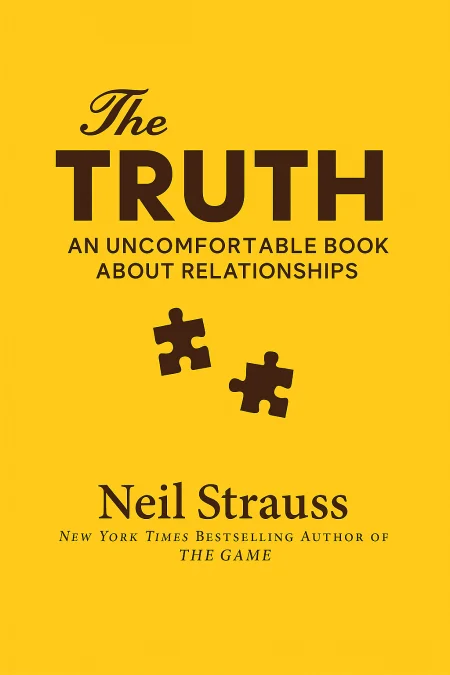
The Truth
An Uncomfortable Book About Relationships
Book Edition Details
Summary
Neil Strauss shattered the bounds of his own reality, morphing from an awkward everyman into the charismatic enigma known as Style. Yet, this transformation wasn't without consequence. While mastering the art of seduction, Strauss found himself adrift in a sea of fleeting encounters, his life a kaleidoscope of temporary connections. But when a single woman emerged from the crowd, demanding more than just transitory affection, Strauss faced a pivotal choice: continue his relentless pursuit of conquest or embrace the terrifying depths of true intimacy. Through this crucible, he unearths buried secrets and faces the haunting shadows of his past. "The Truth" is an electrifying exploration of desire, authenticity, and the turbulent dance between freedom and commitment. Here, Strauss invites readers to question their own relationships, challenging the conventional wisdom on love and fidelity.
Introduction
In the landscape of modern relationships, few journeys are as raw and unflinching as one man's descent into the depths of sexual compulsion and his subsequent quest for authentic connection. This is the story of a successful writer who seemingly had everything—career, recognition, and a loving girlfriend—yet found himself trapped in patterns of deception and betrayal that threatened to destroy everything he held dear. His path from the heights of professional success to the sterile corridors of a psychiatric facility reveals the complex interplay between childhood trauma, societal expectations, and the human need for both security and freedom. What unfolds is not merely a tale of personal failure and redemption, but a broader examination of how we love, commit, and relate to one another in an age of infinite options and diminishing certainties. Through this deeply personal narrative, readers will discover the hidden forces that shape our most intimate relationships, the courage required to confront uncomfortable truths about ourselves, and the possibility of finding authentic love beyond conventional boundaries. This journey illuminates the gap between what society tells us we should want and what our hearts actually crave, offering insights into the nature of commitment, the meaning of fidelity, and the price of living an examined life.
The Disease of Desire: Sex Addiction and Recovery
The story begins with a moment of reckoning that arrives through the cold glow of a smartphone screen. A single email from a woman named Juliet shatters the carefully constructed facade of a seemingly perfect relationship, revealing months of deception and betrayal. The protagonist finds himself confronting not just the immediate consequences of his infidelity, but the deeper question of why someone who professes to love his girlfriend would repeatedly risk everything for fleeting encounters with other women. The journey into treatment reveals a world where desire itself is pathologized, where the natural impulses that drive human sexuality are reframed as symptoms of a progressive disease. In the sterile environment of a psychiatric facility, surrounded by other men grappling with similar compulsions, he encounters a system that promises healing through complete surrender of sexual autonomy. The treatment model demands not just abstinence from cheating, but from masturbation, fantasy, and even appreciative glances at attractive strangers. Yet beneath the clinical terminology and twelve-step programs lies a more fundamental struggle with the nature of male sexuality itself. The protagonist wrestles with whether his desires represent a genuine pathology requiring lifelong management, or simply the collision between evolutionary programming and modern relationship expectations. His fellow patients—married men who've lost houses, families, and fortunes in pursuit of sexual variety—serve as both cautionary tales and mirrors reflecting his own internal conflicts. The treatment process forces a confrontation with childhood trauma and family dysfunction, revealing how early experiences of emotional enmeshment and parental dysfunction can distort adult relationships. Through intensive therapy sessions, he begins to understand how his mother's inappropriate emotional dependence created patterns of intimacy avoidance and compulsive sexual seeking that would plague his adult relationships.
Breaking Free: Questioning the System of Monogamy
As months of treatment unfold, a growing skepticism emerges about the fundamental assumptions underlying sex addiction therapy. The protagonist begins to question whether the problem lies not in his desires themselves, but in a social system that demands the impossible: complete sexual exclusivity for life. His research into evolutionary psychology and anthropology reveals that humans may be naturally inclined toward serial monogamy combined with occasional infidelity—a pattern that served our ancestors well but creates tremendous suffering in modern committed relationships. The tension between natural impulses and social expectations becomes increasingly apparent as he struggles to maintain the rigid behavioral modifications demanded by his treatment program. Despite months of therapy, group meetings, and pharmaceutical interventions, the fundamental desire for sexual variety remains unchanged. This leads to a profound questioning of whether the cure might be worse than the disease, whether the attempt to suppress natural desires creates more suffering than accepting and working with them. His relationship with Ingrid becomes a laboratory for testing these competing philosophies. Despite his genuine love for her and his commitment to change, he finds himself increasingly resentful of the constraints imposed by monogamous expectations. The very effort to be faithful becomes a source of tension, as every attractive woman encountered becomes a test of his recovery, every fantasy a potential relapse, every moment of wandering attention a sign of moral failure. The breaking point comes when he realizes that his attempts to become the perfect monogamous partner have transformed him into someone he no longer recognizes. The spontaneity, passion, and authenticity that originally attracted Ingrid have been replaced by careful self-monitoring and constant vigilance against his own desires. The relationship that was supposed to be saved by his recovery instead becomes another casualty of his internal war between nature and nurture, desire and duty.
Alternative Paths: Exploring Polyamory and Open Relationships
The decision to leave monogamy behind opens up a world of alternative relationship structures that promise to reconcile the competing needs for both security and freedom. The protagonist's exploration of polyamory introduces him to a community of people who have rejected traditional relationship models in favor of arrangements that allow for multiple loving connections. These range from hierarchical structures with primary and secondary partners to more egalitarian group relationships where all members have equal status. His initial encounters with the polyamory community reveal both its potential and its pitfalls. While the philosophical framework of ethical non-monogamy appeals to his rational mind, the practical realities prove more challenging. The community itself often seems populated by individuals fleeing their own relationship traumas rather than those who have achieved genuine emotional maturity. The promise of compersion—feeling joy at a partner's other relationships—proves easier to embrace in theory than in practice. The exploration extends beyond polyamory to other forms of consensual non-monogamy, including swinging communities and modern interpretations of ancient relationship structures. Each offers different solutions to the fundamental tension between human pair-bonding instincts and the desire for sexual variety. Some emphasize emotional connection across multiple relationships, while others focus purely on sexual freedom within the context of a committed primary partnership. Yet as he delves deeper into these alternative communities, a pattern emerges that mirrors his earlier experiences with sex addiction treatment. Many participants seem driven more by reaction against conventional relationships than by a clear vision of what they actually want. The freedom these structures promise often comes with its own set of rules, expectations, and potential for emotional chaos that can be just as constraining as traditional monogamy.
Finding Balance: The Search for Authentic Connection
The final phase of this journey involves a deeper reckoning with the fundamental question of what authentic love actually requires. Having explored both the rigid constraints of enforced monogamy and the apparent freedom of alternative relationship structures, the protagonist must confront whether either path truly serves his deepest needs for connection and meaning. The search for the perfect relationship model gives way to a more nuanced understanding of how individual psychology, cultural conditioning, and genuine compatibility interact to create or destroy intimacy. The process reveals that the problem may not be finding the right relationship structure, but rather developing the emotional maturity to engage authentically within whatever structure is chosen. The childhood wounds that drove both his compulsive sexual behavior and his fear of intimacy require healing regardless of whether he pursues monogamy or polyamory. True freedom emerges not from having unlimited options, but from the ability to make conscious choices based on genuine self-knowledge rather than unconscious compulsions. The exploration of alternative relationships ultimately serves as a mirror, reflecting back his own capacity for love, commitment, and emotional growth. Each encounter with potential partners reveals more about his own patterns, needs, and limitations than about the viability of any particular relationship model. The journey becomes less about finding the perfect partner or structure and more about becoming the kind of person capable of creating authentic intimacy regardless of the external circumstances. In the end, the question of monogamy versus non-monogamy proves less important than the deeper questions of honesty, vulnerability, and the courage to love fully despite the risks involved. The path forward requires not just intellectual understanding of different relationship options, but the emotional intelligence to navigate them with integrity and compassion for all involved. The search for authentic love reveals itself to be not a destination to be reached, but a practice to be cultivated throughout a lifetime of conscious relating.
Summary
This profound exploration of modern love reveals that the crisis facing contemporary relationships extends far beyond individual pathology to encompass the fundamental mismatch between human nature and social expectations. The journey from compulsive infidelity through treatment and into alternative relationship structures illuminates how childhood trauma, cultural conditioning, and evolutionary programming combine to create the relationship challenges that plague so many people today. Rather than offering simple answers about the superiority of monogamy or polyamory, this story demonstrates that authentic love requires the courage to examine our deepest assumptions about commitment, fidelity, and what it means to truly know and accept another person. The most valuable insight emerging from this odyssey is that relationship structures matter far less than the emotional maturity and self-awareness we bring to them. Whether pursuing traditional marriage or exploring alternative arrangements, success depends on our ability to act from consciousness rather than compulsion, to communicate honestly about our needs and limitations, and to extend compassion to ourselves and others as we navigate the complex terrain of human intimacy. This story will resonate particularly with those questioning conventional relationship models, anyone struggling with the tension between security and freedom in love, and readers seeking a more honest conversation about the realities of desire, commitment, and the ongoing challenge of creating authentic connection in an age of infinite options.
Related Books
Download PDF & EPUB
To save this Black List summary for later, download the free PDF and EPUB. You can print it out, or read offline at your convenience.
By Neil Strauss
